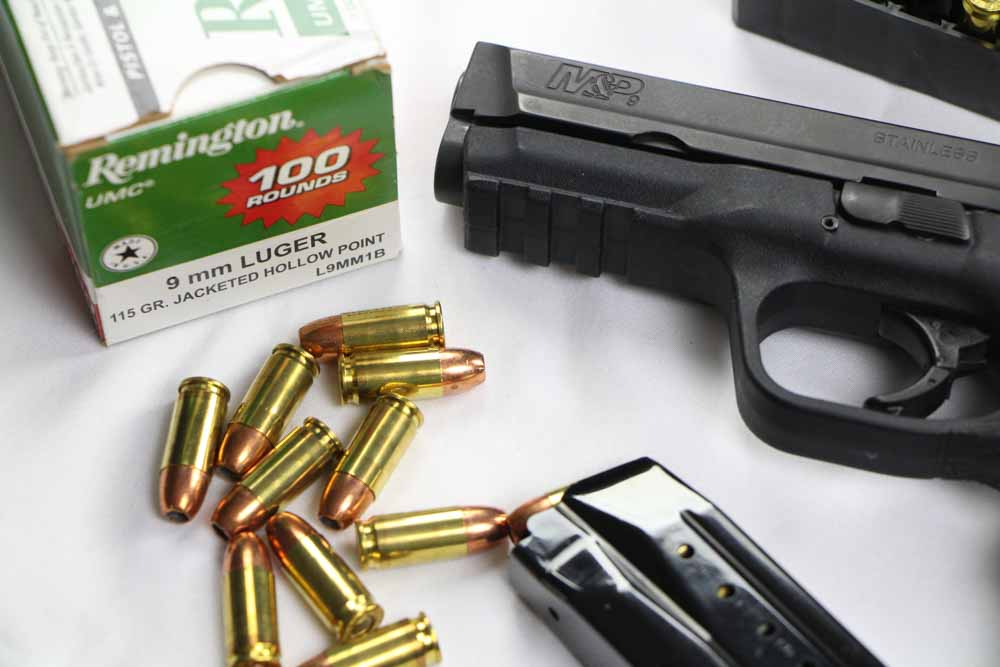
This speed of sound calculator is intended to help sound suppressor enthusiasts. Temperature changes impact the speed of sound, so your subsonic ammunition might unexpectedly become supersonic.
Instructions for Using the Speed of Sound Calculator
The calculator is simple and returns the speed of sound in feet per second (fps). FPS is typically used in the firearms community.
- Type in the air temperature in the box labeled “Temperature.” You can use whole numbers or decimals.
- From the “Unit” dropdown, choose either °F (Fahrenheit) or °C (Celsius).
- Click the Calculate button.
- Look just below the button for the result line, which will read
- Speed of Sound: ft/s
- If the number is 1,000 ft/s or higher, it will include commas (for example, 1,127 ft/s).
- If you see “Please enter a valid temperature,” it means the field is blank or contains a non-numeric value. Just re-enter a numeric value and try again.
About the Speed of Sound Calculator
The speed of sound is a foundational concept in physics and engineering, affecting fields as varied as acoustics, meteorology, and aerospace. A Speed of Sound Calculator allows users to determine the velocity at which sound propagates through various media under different physical conditions. This article explores the science behind the speed of sound, describes how a calculator functions, examines influencing parameters, and explains practical applications.
What Is the Speed of Sound?
The speed of sound is the rate at which acoustic waves travel through a material. In dry air at 20°C (68°F), this speed is approximately 343 meters per second (m/s). The value, however, changes with the state of the medium (solid, liquid, or gas), its temperature, pressure, density, and humidity. Understanding these dependencies is crucial for accurate calculations.
The Science: Equations and Key Factors
1. Physics Background
Sound travels as a mechanical wave, requiring a medium—air, water, steel, etc.—to propagate. The velocity at which it moves depends on the medium’s elastic properties (such as bulk modulus) and inertia (density).
2. General Equation for Gases (Ideal Gas Law)
The speed of sound in a dry ideal gas is given by:
[ v = \sqrt{ \gamma \cdot \frac{R \cdot T}{M} } ]
Where:
- ( v ) = speed of sound (m/s)
- ( \gamma ) = adiabatic index (1.4 for air)
- ( R ) = universal gas constant (8.314 J/mol·K)
- ( T ) = absolute temperature (Kelvin)
- ( M ) = molar mass of the gas (kg/mol)
3. Influence of Temperature
Temperature has a direct effect. For air:
[ v_{air} = 331.3 + 0.606 \cdot T_{C} ] ( T_C ): temperature in degrees Celsius.
4. Pressure and Humidity
- Pressure: In ideal gases, at constant temperature, pressure does not affect the speed—because both density and elastic modulus are proportional to pressure.
- Humidity: Increasing humidity lowers air density, which increases the speed of sound.
5. Other Media
- Water: Sound is faster (?1,480 m/s at 20°C).
- Steel: Much faster (?5,960 m/s).
Speed of Sound Calculator: How It Works
A Speed of Sound Calculator is a web-based scientific calculator, that automates the computation based on user input.
Input Parameters:
- Medium (air, water, steel, etc.)
- Temperature (°C, °F, or K)
- Humidity (for air)
- Pressure
- Altitude (affects air pressure and density)
Output:
- Calculated speed of sound in chosen units (m/s, ft/s, etc.)
Algorithm Steps:
- User Selection: Choose the medium.
- Environmental Inputs: Enter temperature, and where relevant, humidity and pressure.
- Equation Selection: The calculator uses the proper formula for the medium.
- Computation: Performs calculation, rounding as needed.
- Result: Displays speed of sound.
Why a Speed of Sound Calculator Only Needs Temperature at the Muzzle of a Firearm
When calculating the speed of sound at the muzzle of a firearm, temperature is the only environmental input that significantly affects sound speed at that precise location. This is rooted in the physics governing sound propagation in air, particularly under the brief, localized conditions present when a bullet leaves the barrel. Here’s why:
1. Pressure Effects Are Negligible
At the muzzle, air pressure is nearly equal to the surrounding atmospheric pressure. Although pressure can dramatically change within the barrel due to combustion gases, the moment sound escapes the muzzle, it immediately encounters the ambient air. For an ideal gas like air, the speed of sound is independent of pressure provided temperature remains constant. This is because increases in air pressure are exactly offset by proportional increases in density, leaving the speed unchanged.
2. Humidity Has Minimal Impact
While humidity can affect the speed of sound very slightly (by lowering air density), the effect—especially within the short distance and rapid timescale at the muzzle—is negligible for ballistic and forensic purposes. Most firearm sound calculations (such as for bullet flight time or supersonic vs. subsonic transition) only require accuracy within a fraction of a percent, which temperature alone provides.
3. Altitude is Accounted for by Temperature
Although altitude changes air pressure and density, these changes primarily impact the speed of sound through their influence on temperature. Given that the speed of sound formula for air at typical atmospheric pressures is:
[ v_{air} = 331.3 + 0.606 \cdot T_C ]
where ( T_C ) is the air temperature in Celsius, altitude only matters to the extent that it changes local air temperature.
4. Local Conditions Dominate at the Muzzle
At the instant a bullet leaves the barrel, external factors like wind, long-distance humidity gradients, or temperature layers have not had time to affect the sound. The immediate environment determines the speed at which the sound wavefront (muzzle blast, bullet crack) propagates.
5. Practical Usage in Ballistics
Ballistics calculators and forensic acoustics professionals rely on temperature-only input for muzzle location computations to:
- Estimate Mach number (how much faster than sound a bullet is traveling).
- Synchronize acoustic sensors for shot localization.
- Model sonic boom signatures.
The scientific consensus and equations used confirm that the temperature at the measurement location – the muzzle – is the sole required parameter for a reliable calculation of the speed of sound in firearm contexts.
To determine the speed of sound at the muzzle of a firearm, a calculator requires only the temperature at the muzzle, as pressure and humidity have minimal influence under standard atmospheric conditions, and all other variables are either negligible or encapsulated by temperature. This ensures both practical simplicity and sufficient scientific accuracy for all purposes related to firearms acoustics and ballistics.