
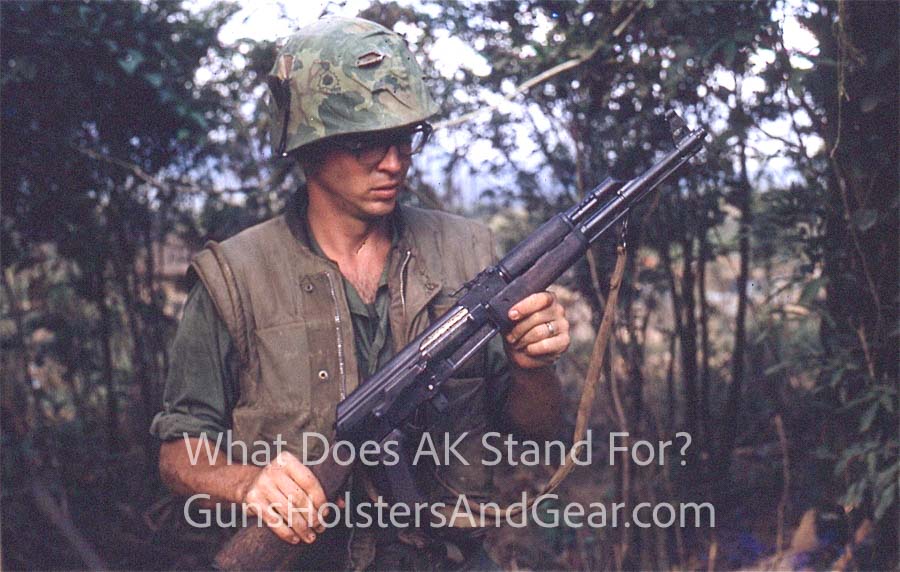
AK stands for Avtomat Kalashnikova, which translates to “Kalashnikov’s automatic rifle” in English. The designation honors Mikhail Timofeyevich Kalashnikov, the Soviet weapons designer who created this assault rifle in 1947. The number following AK indicates the year when that specific model was finalized for production. So AK-47 literally means “Kalashnikov’s automatic rifle, model of 1947.”
Now here’s what most people get wrong. When you see an “AK” in a movie or at a range, chances are pretty high you’re not looking at an actual AK-47. Most are AKM rifles, a modernized version from 1959, or variants built in other countries. The original AK-47, with its milled receiver, was in production from 1948 to 1959, before the Soviet military adopted the improved AKM. But the AK-47 name stuck in popular culture, so now everything that looks like a Kalashnikov gets called an AK-47.
The Russian Origin: Breaking Down Avtomat Kalashnikova
Let’s start with the Russian. Avtomat Kalashnikova breaks into two parts. “Avtomat” means automatic, referring to the rifle’s gas-operated, selective-fire mechanism. This isn’t about full-auto-only machine guns. Soviet doctrine used “avtomat” specifically for assault rifles: weapons that could switch between semi-automatic and automatic fire modes using an intermediate cartridge.
“Kalashnikova” is the possessive form of Kalashnikov. In Russian naming conventions, this indicates ownership or creation by someone named Kalashnikov. Similar patterns appear throughout Soviet weapons nomenclature. The PPSh submachine gun stands for Pistolet-Pulemyot Shpagina (Shpagin’s submachine gun). The Mosin-Nagant rifle carries the names of its designers, Sergei Mosin and Léon Nagant.
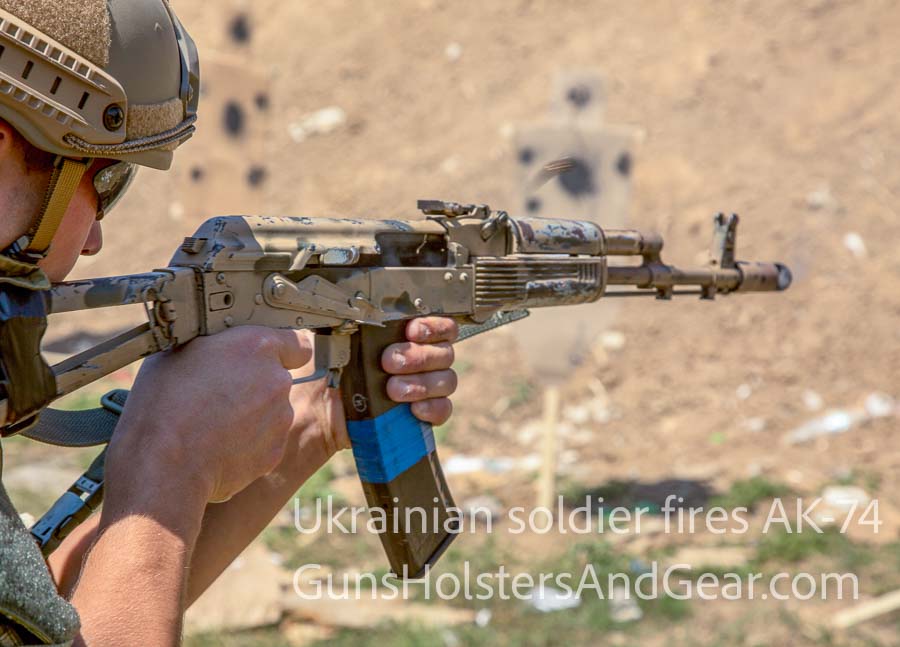
A Ukrainian soldier fires an AK-74 Assault Rifle during training with U.S. special operations troops in Ochakiv, Ukraine, July 18, 2017. Image: U.S. Dept. of War
The number suffix tells you when the design was finalized. The AK-47 was presented for official military trials in 1947, hence the designation. When Kalashnikov updated the design with a stamped receiver and other improvements in 1959, it became the AKM—Avtomat Kalashnikova Modernizirovanny (Kalashnikov’s automatic rifle, modernized). The 1974 adoption of a smaller 5.45×39mm cartridge led to the AK-74. Each number marks a significant evolution in the platform.
This naming system was practical. Soviet military logistics needed clear identification for different weapon types. When a soldier requested an “AK-47,” everyone knew exactly what rifle model, what ammunition, what spare parts, and what manual they needed. The system avoided confusion across the massive Soviet military apparatus and its Warsaw Pact allies.
Mikhail Kalashnikov: The Designer Behind the Designation
Mikhail Timofeyevich Kalashnikov was born on November 10, 1919, in the village of Kurya in Russia’s Altai region. He came from a peasant family, the 17th of 19 children. In 1930, Stalin’s collectivization policies labeled his family as kulaks, and they were deported to Siberia. Everything they owned was confiscated. The family survived through a combination of farming and hunting, which meant young Mikhail grew up familiar with firearms.
He wasn’t formally trained as an engineer. After completing seventh grade, he left his family and returned to Kurya, where he worked at a tractor station. He showed natural mechanical aptitude: the kind where you can look at a machine and understand how it works without anyone explaining it. In 1938, he was drafted into the Red Army and assigned to a tank regiment in the Kiev Special Military District, serving as a tank mechanic and later tank commander.
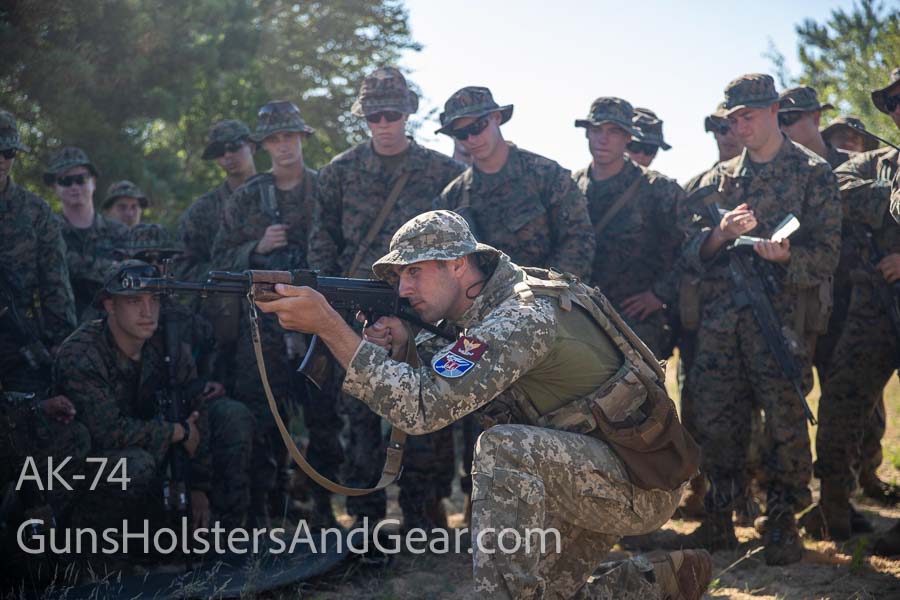
His design career started in the military. While serving in a tank unit, he developed several inventions: a tank shot counter, an engine hour meter, and improvements to the TT pistol for use through tank firing ports. His commanders noticed. These weren’t revolutionary innovations, but they demonstrated practical thinking about how soldiers actually used equipment in the field. That attention to real-world use would define his later work.
In October 1941, Kalashnikov was wounded in the shoulder at the Battle of Bryansk during the German invasion. He was hospitalized until April 1942. During his hospital recovery, he spoke with soldiers complaining about Soviet infantry weapons. The PPSh submachine gun was effective at close range but lacked accuracy beyond 100 meters. The Mosin-Nagant rifle was accurate but slow.
According to stories, Kalashnikov started sketching designs while still recovering. His first submachine gun design was rejected, but military officials recognized his talent. In 1942, he was assigned to the Central Scientific-Developmental Firing Range for Rifle Firearms. In 1944, he designed a gas-operated carbine for the new Soviet 7.62×39mm cartridge. It lost to the Simonov SKS, but it became the foundation for his assault rifle work.
For the 1946 assault rifle competition, Kalashnikov submitted his design under the alias “Mikhtim,” an abbreviation of Mikhail Timofeyevich. He was competing against two legendary Soviet weapons designers: Vasily Degtyaryov and Georgy Shpagin, both far more experienced. But his design won. What made it superior wasn’t exotic engineering or advanced materials. It was simplicity, reliability, and manufacturability – exactly what the Soviet military needed for mass production.
The AK Family: Understanding Different Models
The original AK-47 underwent three production variants between 1948 and 1959. Type 1 (1948-1951) featured a stamped receiver, but manufacturing difficulties with welding the guide rails led to high rejection rates. Type 2 (1951-1954) switched to a milled receiver to solve production issues. Type 3 (1954-1959) continued with the milled receiver but included refinements that made it lighter and easier to manufacture. These early models weighed about 9.5 pounds empty and fired the 7.62×39mm intermediate cartridge from 30-round magazines.
In 1959, the Soviet military adopted the AKM: Avtomat Kalashnikova Modernizirovanny. The AKM solved the stamped receiver manufacturing issues that plagued the Type 1 and reduced weight by about 2.2 pounds through various improvements. It added a slanted muzzle compensator to reduce muzzle climb during automatic fire. The stamped receiver featured reinforcing dimples to stabilize magazines.
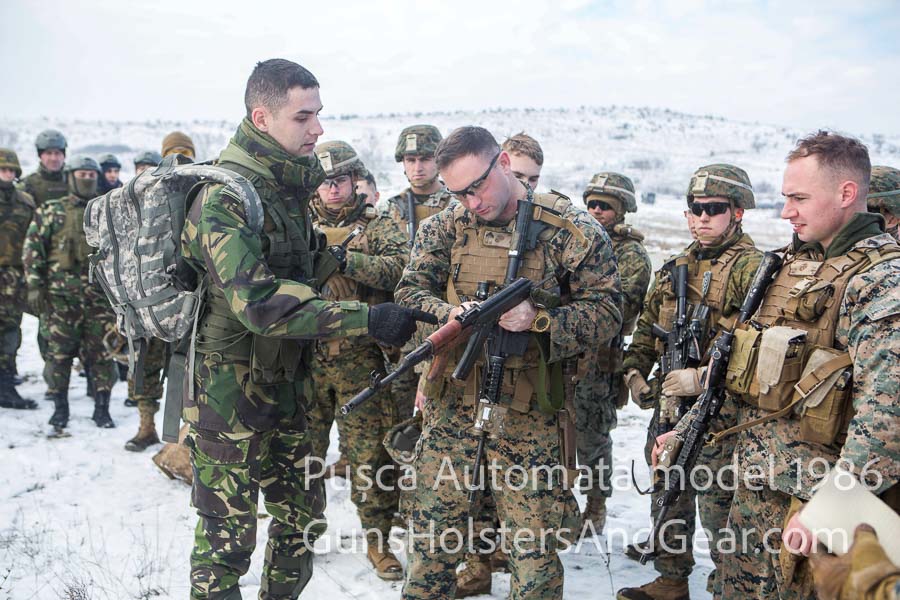
Here’s a key point that trips people up: most rifles people call AK-47s are actually AKMs. The AKM became the standard Soviet infantry rifle and was produced in enormous quantities – easily 10 million or more units. It was also licensed to other countries including Poland, East Germany, China, and Bulgaria. The Chinese Type 56, the Egyptian Maadi, the Romanian AIM—these are all AKM variants. When you see an AK in a movie or video game from the 1970s onward, it’s almost certainly an AKM.
The AK-74 represents a fundamental shift. In the 1970s, NATO militaries had largely switched to smaller, lighter 5.56×45mm ammunition. The Soviet Union wanted similar advantages, so it developed the 5.45×39mm cartridge. The AK-74 chambered this new round. It entered service in 1974 (hence the designation) and was first deployed during the Soviet-Afghan War.
The AK-74 weighs about 7 pounds empty—two pounds lighter than an AKM. The 5.45×39mm produces less recoil than 7.62×39mm, making the rifle easier to control in automatic fire. The AK-74 features a large, distinctive muzzle brake with multiple ports. It has a 90-degree gas block to reduce gas port erosion. The rear sight was recalibrated for the different ballistics of 5.45×39mm. Magazines have a different curve, less pronounced than AKM magazines, and include a raised rib to prevent accidentally loading them into a 7.62×39mm rifle.
The AK-74M, adopted in 1991, modernized the AK-74. It features a side-folding polymer stock, a side rail for optics mounting, and updated furniture. It became the standard rifle for the new Russian Federation after the Soviet Union collapsed. It remains in Russian military service today, though newer AK-12 and AK-15 variants are gradually replacing it.
There are dozens of other variants. The AKMS has an under-folding stock. The AKS-74U is a shortened carbine version (the U stands for Ukorochennyy, or “shortened”). The AK-101, AK-102, AK-103, and AK-104 are modern export variants chambered in different calibers. The AK-12, introduced in 2018, features improved ergonomics, accessory rails, and burst-fire modes. Each variation serves specific military or commercial requirements while maintaining the core Kalashnikov operating system.
How the AK-47 Operating System Works
Understanding what makes an AK an AK requires understanding its operating mechanism. The rifle uses a gas-operated, rotating bolt system. When you fire, expanding gases from the burning gunpowder propel the bullet down the barrel. About midway down the barrel, a small port allows some of that gas to flow into a tube above the barrel.
That gas pushes against a piston attached to the bolt carrier. The piston drives the carrier backward. As the carrier moves, it rotates the bolt to unlock it from the receiver. The carrier then extracts the spent cartridge case from the chamber and ejects it through the ejection port on the right side. A spring underneath the top cover compresses during this rearward movement.
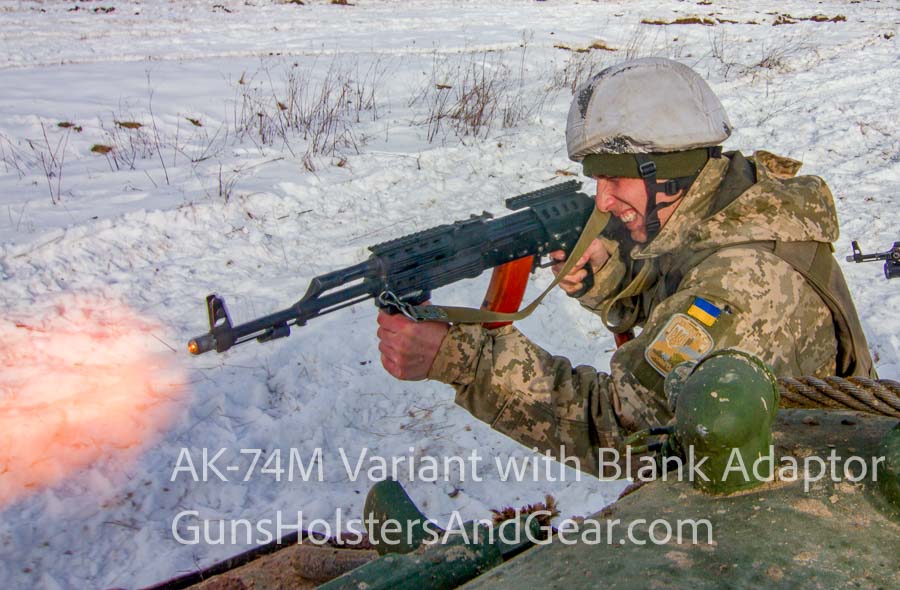
A Ukrainian soldier assigned to 3rd Battalion, 14th Mechanized Brigade fires an AK-74 rifle during a section blank-fire training event at the Yavoriv Combat Training Center. Image: U.S. Army
The spring then pushes the carrier forward. As it moves forward, it strips a new cartridge from the magazine and chambers it. The bolt rotates to lock into the receiver again. The hammer remains cocked, ready for the next shot. If you’re firing in automatic mode, the trigger mechanism allows this cycle to repeat continuously as long as you hold the trigger. In semi-automatic mode, the rifle fires once per trigger pull.
This system prioritizes reliability over tight tolerances. The AK has relatively loose clearances between moving parts. There’s deliberate space between the bolt and the receiver. The gas system is overgassed—it uses more gas than strictly necessary to cycle the action. These design choices reduce sensitivity to dirt, sand, mud, and carbon buildup. An AK can function in conditions that would jam more precision-built rifles.
The trade-off is accuracy. Those loose tolerances mean parts can move slightly during firing, affecting shot placement. An AK-47 typically shoots 4-6 inch groups at 100 yards—adequate for combat but not match-grade. The heavy, long-stroke piston creates reciprocating mass that affects barrel harmonics. The sights are functional but basic: a simple post front sight and a notch rear sight calibrated in 100-meter increments out to 800 or 1000 meters.
The 7.62×39mm cartridge itself was designed as an intermediate round—more powerful than a pistol cartridge but less powerful than full-rifle cartridges like 7.62×54mmR or .30-06. It fires a 123-grain bullet at roughly 2,350 feet per second from an AK-47. Effective range against human targets is about 300-400 meters. The round has significant drop beyond that due to its relatively heavy, slow bullet.
Kalashnikov designed every part with manufacturability in mind. The stamped receiver (in the AKM) can be produced on simple pressing equipment. Most parts require minimal machining. Field stripping requires no tools—you can completely disassemble the rifle to its major components in under 30 seconds. Reassembly is equally fast. This simplicity enabled the Soviet Union to produce millions of rifles and train conscripts to maintain them with minimal instruction.
Global Proliferation: How AK Became a Universal Term
The AK-47 spread globally through multiple channels. During the Cold War, the Soviet Union supplied AK rifles to communist and socialist allies at low cost or no cost. They armed North Vietnam, Cuba, Egypt, Syria, various African liberation movements, and anyone else aligned against Western interests. China produced its own copies, the Type 56, and distributed them throughout Asia and Africa.
Many countries established licensed production. Poland, Romania, Bulgaria, East Germany, Yugoslavia, North Korea, and others built factories to manufacture AK variants. After the Soviet Union collapsed in 1991, massive stockpiles became available on the global arms market. Weapons flowed out of former Soviet republics, often through gray or black markets. Wars in the Balkans, Africa, and the Middle East created additional distribution networks.
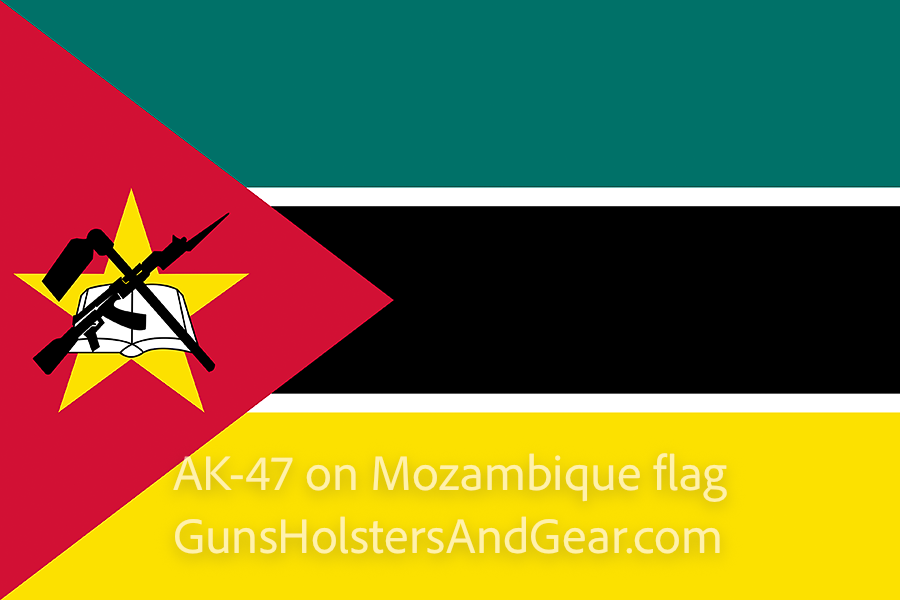
Estimates suggest 100 million AK-pattern rifles exist worldwide, though exact numbers are impossible to verify. For context, that’s more than any other firearm model in history. The rifle appears on Mozambique’s flag, symbolizing the country’s liberation struggle. It’s been used in virtually every armed conflict since the 1950s, from Vietnam to Afghanistan to Iraq to Syria.
In the United States, semi-automatic AK variants became popular civilian firearms. Federal import restrictions limited direct imports of military AKs, but variants built from parts kits or manufactured domestically filled the market. Companies like Century Arms, Arsenal Inc., and Palmetto State Armory produce American-made AK variants. These semi-automatic rifles appeal to shooters who want a reliable, affordable rifle with historical significance and widespread ammunition availability.
The rifle’s simplicity also made it attractive for illicit manufacture. Small workshops in places like Khyber Pass in Pakistan could produce functioning AK copies with basic metalworking equipment. Quality varied wildly, from near-factory specification to dangerous improvised weapons, but the design’s fundamental soundness meant even crude copies often worked.
This ubiquity means “AK” became shorthand for any Kalashnikov-pattern rifle regardless of specific model or origin. A Pakistani-made Type 56 copy? People call it an AK. A Romanian AIM? An AK. A modern Russian AK-74M? Still an AK. The designation transcended its original meaning to become a generic term for an entire weapons family.
Common Misconceptions About What AK Means
Let’s clear up some widespread confusion. First, AK does not stand for “assault rifle.” That’s a backronym: a false explanation created after the fact. The actual Russian designation is Avtomat Kalashnikova, and “avtomat” translates to “automatic” or “automatic rifle,” not “assault.” The term “assault rifle” is a functional classification, not part of the weapon’s name.
Second, AK-47 is not an acronym for “47 rounds” or “47 caliber” or anything involving the number 47 except the year. The 47 specifically refers to 1947, the year Kalashnikov’s design was presented for military trials. AK-47s use 30-round magazines as standard, though 10, 20, 40, and 75-round magazines exist. The caliber is 7.62×39mm, not .47 caliber.
Third, the “K” does not stand for “Kalashnikov model” or “killing” or anything else creative. It’s simply the K from Kalashnikov’s surname in its possessive form. Russian grammar requires the possessive ending, so Kalashnikov becomes Kalashnikova in the full designation.
Finally, while many people use AK-47 as a catch-all term for any Kalashnikov rifle, technically speaking, an AK-47 refers to the specific models produced from 1948 to 1959. Later rifles are AKMs, AK-74s, or other variants. This distinction matters in collector and historical contexts, though it’s less important in casual conversations where “AK-47” has become synonymous with the entire family.
Final Thoughts: Why Understanding AK Matters
By now, you should be able to answer the question “What does AK stand for?”
The AK-47 and its variants represent successful military design at its core: prioritizing function over form, reliability over precision, simplicity over sophistication. Whether you see AK rifles as tools, weapons, or historical artifacts, their impact on the 20th and 21st centuries cannot be overstated. From Vietnam jungles to Middle Eastern deserts to American shooting ranges, the AK platform persists because the fundamental design works.
For anyone interested in firearms, military history, or Cold War technology, knowing what AK actually means—not what movies suggest or what myths perpetuate—provides insight into how weapons development intersects with politics, manufacturing, and human conflict. The letters AK carry the weight of that history.
Mikhail Kalashnikov designed his rifle as a defensive weapon to protect the Soviet Union from invasion. Whether it succeeded in that limited goal or became something entirely different through global proliferation remains a question for historians and ethicists to debate. But the rifle bearing his name – the Avtomat Kalashnikova -changed the world permanently.