
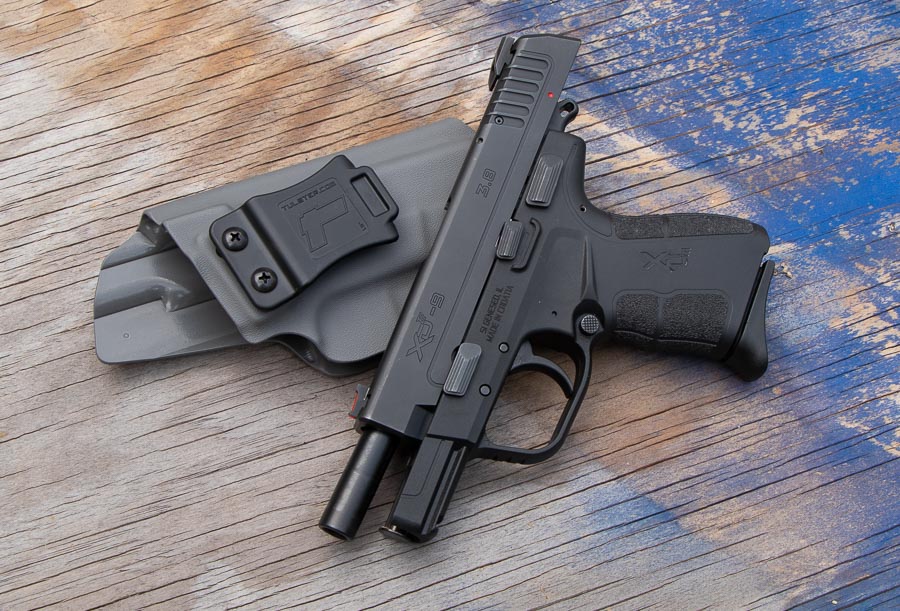
I spent the better part of three months carrying the Springfield XD-E 3.8″ in 9mm. Not as a backup gun and not as a range toy. Instead, I carried it as my primary CCW. I put about 1,200 rounds through it across multiple range sessions, carried it appendix and strong-side, and learned exactly what makes this discontinued hammer-fired pistol different from everything else in the single-stack carry market.
Here’s what I found. The XD-E is not trying to be a Glock 43. It’s not competing directly with the Shield or the P365. This gun occupies a specific niche: one that Springfield apparently decided wasn’t profitable enough to continue producing after 2021. But that doesn’t mean it lacks value.
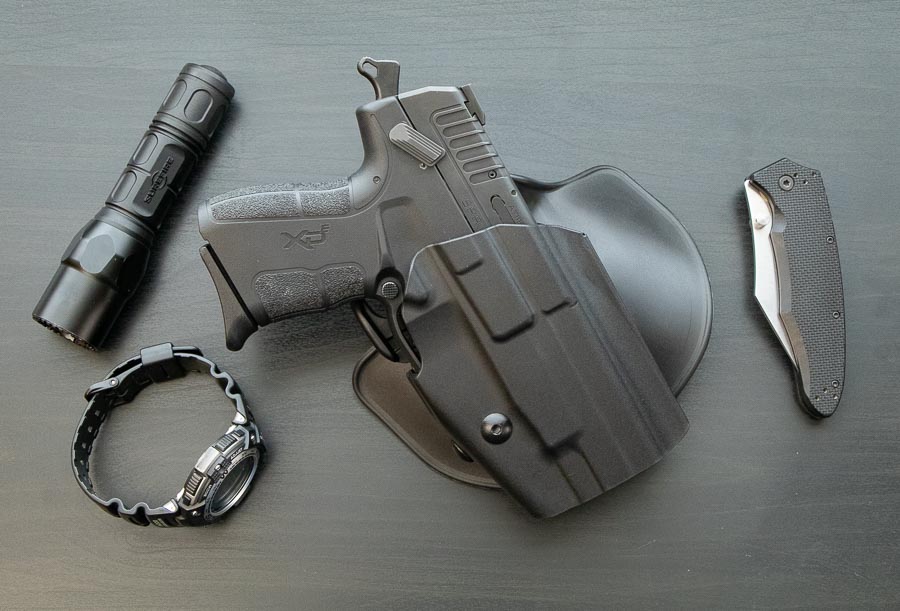
If you’re someone who wants the deliberate control of a DA/SA trigger in a slim, concealable package, or if you’re a new shooter who just doesn’t like striker-fired guns, the XD-E deserves serious consideration. Especially on the used market, where prices are reasonable, and availability is actually decent.
XD-E Design
The XD-E was designed by HS Produkt in Croatia and imported by Springfield Armory. That’s worth mentioning because HS Produkt has a solid reputation for building reliable service pistols. They manufacture the XD series, Echelon pistols and Hellion rifles. Although I’m a “made in the USA” kind of guy, I have no issues with these pistols (nor Austrian-made Glocks and German-made SIGs).
The slide is forged steel with a matte black Melonite finish. It’s corrosion-resistant, and while not fancy, it works. The slide has grasping grooves on each side. They’re broad but shallow: enough for a solid purchase without being aggressive. No forward cocking serrations, which honestly makes sense on a 3.8″ gun where you’re not working with a ton of real estate anyway.
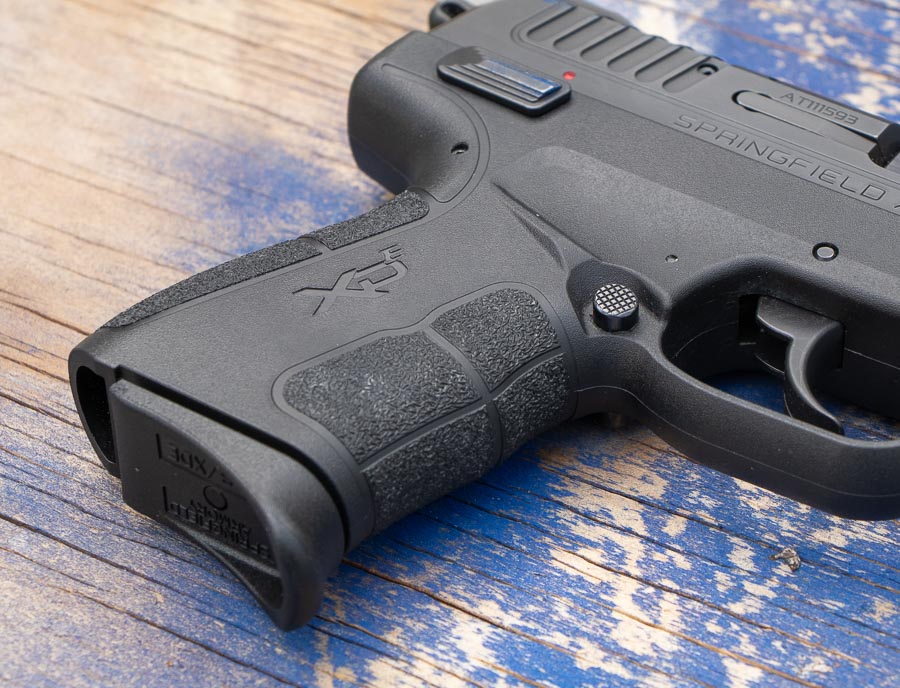
The frame is polymer with Springfield’s Mod.2 texturing. It’s grippy enough to maintain control under recoil but doesn’t shred your hands or your shirt fabric during all-day carry. The grip angle feels natural. Not quite 1911, not quite Glock. Somewhere in between that works for most shooters.
Dimensions on the 3.8″ model: 6.75 inches long, 4.75 inches tall, and exactly one inch wide. Weight comes in around 25 ounces with an empty magazine. That puts it in the same size class as the S&W Shield and Glock 43, though it’s slightly taller due to the exposed hammer.
It has an accessory rail. Short rail, yes, but functional for a compact light if you want one. The smaller 3.3″ version doesn’t have this feature.
Controls are fully ambidextrous. Magazine release works from either side. The safety/decocker lever is bilateral. Slide stop is single-sided on the left, which is standard. Everything is within easy reach without requiring a grip shift in my hands.
Let’s Talk About the Trigger
The defining characteristic of the XD-E is its hammer-fired DA/SA trigger. If you grew up shooting striker-fired pistols, this might seem archaic. If you came up on classic service pistols, it’ll feel immediately familiar.
Double-action first pull: 10 to 11 pounds with a long, smooth stroke. It’s heavier than any striker trigger you’re used to. That’s intentional. The idea is that under stress, a longer, heavier trigger pull reduces the chance of an unintentional discharge.
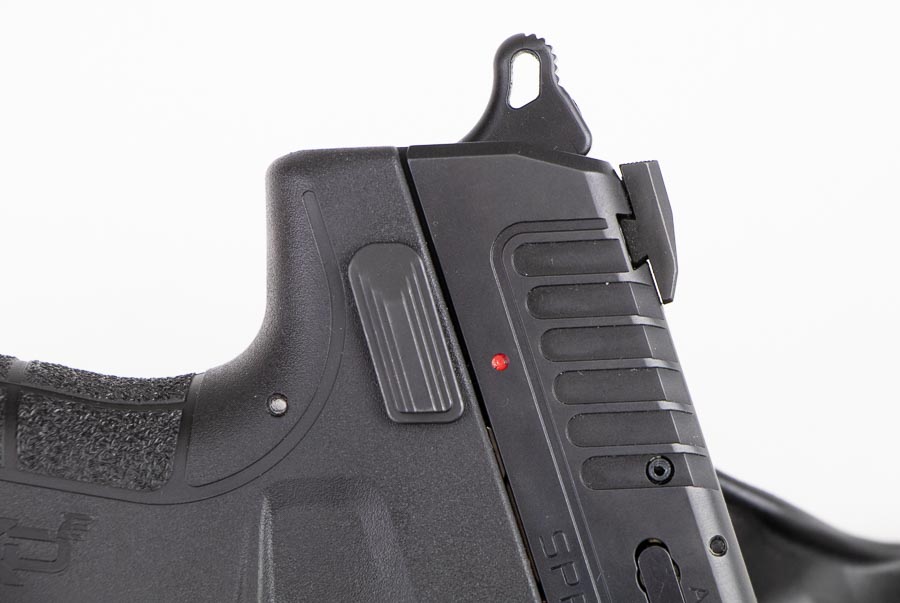
After that first shot, the gun cycles into single-action mode. The hammer stays cocked between shots. SA trigger pull weighs in around 5 to 5.5 pounds with a short reset. Clean break with a small amount of take-up. It’s a legitimate trigger for precision work once you’re past that initial pull.
The frame-mounted lever serves dual purposes. Push down past the fire position and it safely decocks the hammer without pulling the trigger. Push up and it functions as a manual safety, locking the trigger. This gives you three carry options:
- Decocked, hammer down, safety off – traditional DA/SA carry
- Decocked, hammer down, safety on – maximum safety layers
- Cocked and locked, hammer back, safety on – 1911-style
Most people run it in mode one. That’s how I carried it throughout my testing. But if you want the consistency of a single-action trigger for every shot, mode three is there. The safety is easy to sweep off during your draw stroke – my thumb naturally falls right on it.
Low-Effort Slide Isn’t Marketing
Springfield claims the XD-E’s slide requires 27% less force to rack compared to typical striker-fired pistols. I don’t have the equipment to verify that exact number, but I can confirm the slide is noticeably easier to manipulate than my Glock 43 or my Shield.
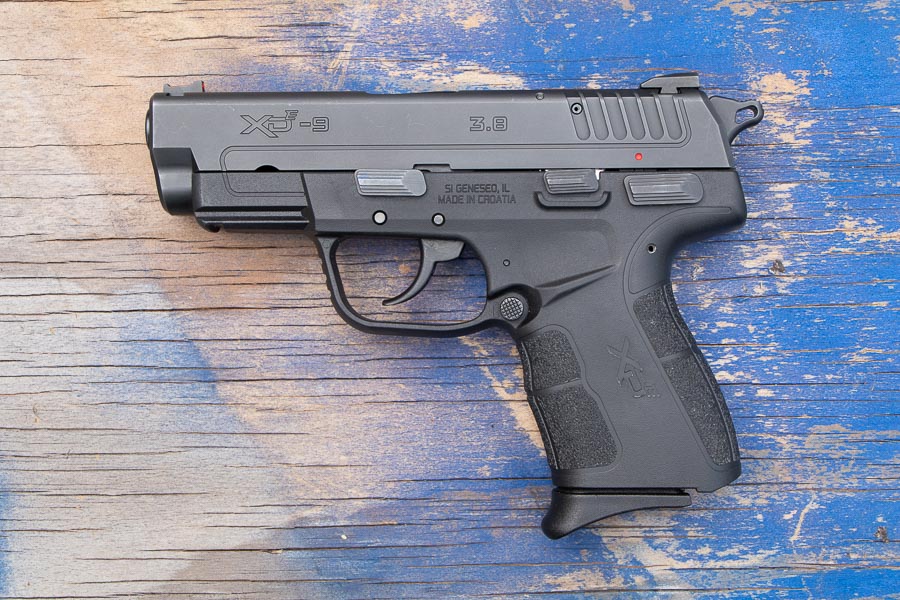
The reason is simple: hammer-fired guns don’t need to compress a striker spring when you rack the slide. The hammer spring does that work when you pull the trigger. This makes the XD-E significantly more accessible for shooters with limited hand strength, arthritis, or anyone who finds striker guns difficult to operate.
Is this a big deal? For some people, absolutely. For others, not at all.
I’ve tested the Smith & Wesson M&P 380 EZ pistol, which is another gun that highlights an easy-to-manipulate slide. The 380 EZ was even easier to rack the slide. If hand strength is a real issue, my first choice would be the M&P EZ.
Sights and Sight Picture
The front sight is fiber-optic with a red insert, which I found bright and fast to acquire. It worked well in various lighting conditions. The rear sight is a low-profile two-dot setup in white.
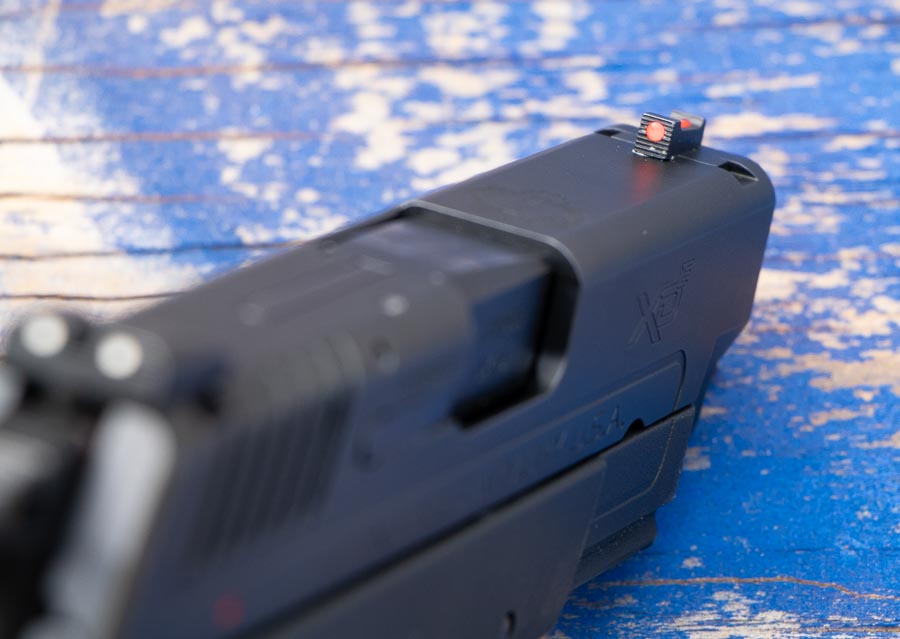
Sight height is compatible with the SIG P-series dovetail dimensions. That means you have aftermarket options if you want night sights or a different configuration. The sights are drift-adjustable for windage.
Range Performance & Accuracy
Accuracy is respectable. At seven yards, I was keeping everything inside a 2-inch circle, shooting DA/SA. Single-action only, I could tighten that to around 1.5 inches without much effort. At 15 yards, groups opened up to about 3 inches, which is perfectly acceptable for a carry gun with a 3.8″ barrel.
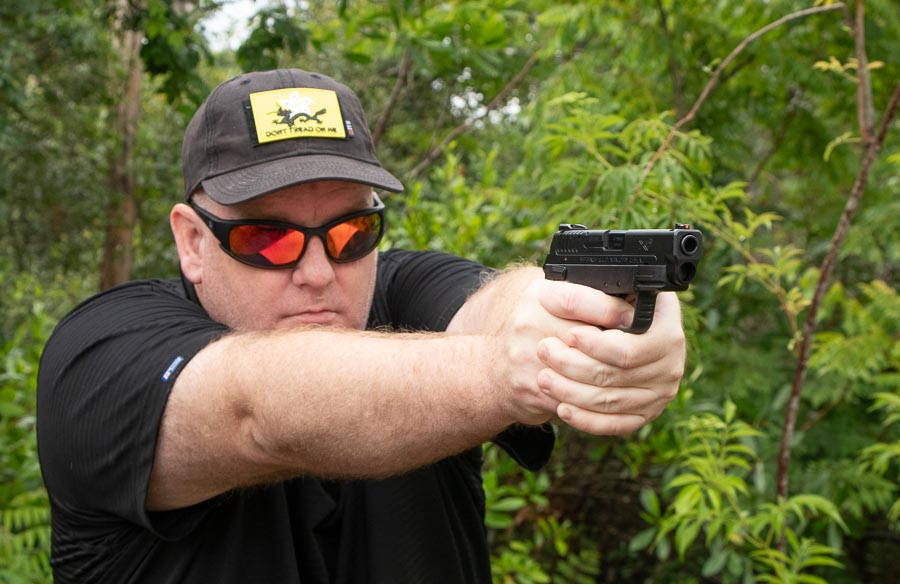
The barrel is hammer-forged. It’s the same barrel Springfield uses across the XD line. I didn’t notice any particular preference for one bullet weight over another. The gun shot 115-grain, 124-grain, and 147-grain loads equally well.
Recoil is manageable. The single-stack grip doesn’t give you as much purchase as a double-stack gun, and you feel that in the recoil impulse.
| Velocity | Energy | |
|---|---|---|
| American Eagle 115-gr FMJ | 1,170 fps | 350 ft-lbs |
| Blazer Brass 115-gr. FMJ | 1,120 fps | 320 ft-lbs |
| Federal BPLE 115-gr. JHP +P+ | 1,277 fps | 416 ft-lbs |
| Federal HST Tactical 147-gr JHP | 991 fps | 321 ft-lbs |
| Liberty Ammunition Civil Defense 50-gr. JHP | 2,064 fps | 473 ft-lbs |
| PMC Bronze 115-gr. FMJ | 924 fps | 218 ft-lbs |
| Remington UMC 115-gr. JHP | 1,128 fps | 325 ft-lbs |
| Sellier & Bellot 115-gr. JHP | 1,168 fps | 348 ft-lbs |
| Sig Sauer V-Crown 115-gr. JHP | 1,204 fps | 370 ft-lbs |
| Sig Sauer V-Crown 124-gr. JHP | 1,010 fps | 281 ft-lbs |
| Sig Sauer V-Crown 147-gr. JHP | 957 fps | 299 ft-lbs |
| Speer Gold Dot 124-gr. JHP | 1,111 fps | 340 ft-lbs |
| Wolf Military Classic 115-gr. FMJ | 1,122 fps | 321 ft-lbs |
If you are recoil sensitive, a larger gun can help absorb the recoil impulse. If you are dealing with grip strength issues, I again refer you back to the S&W 380 EZ. Chambered for the .380 ACP cartridge, it is a softer shooing gun.
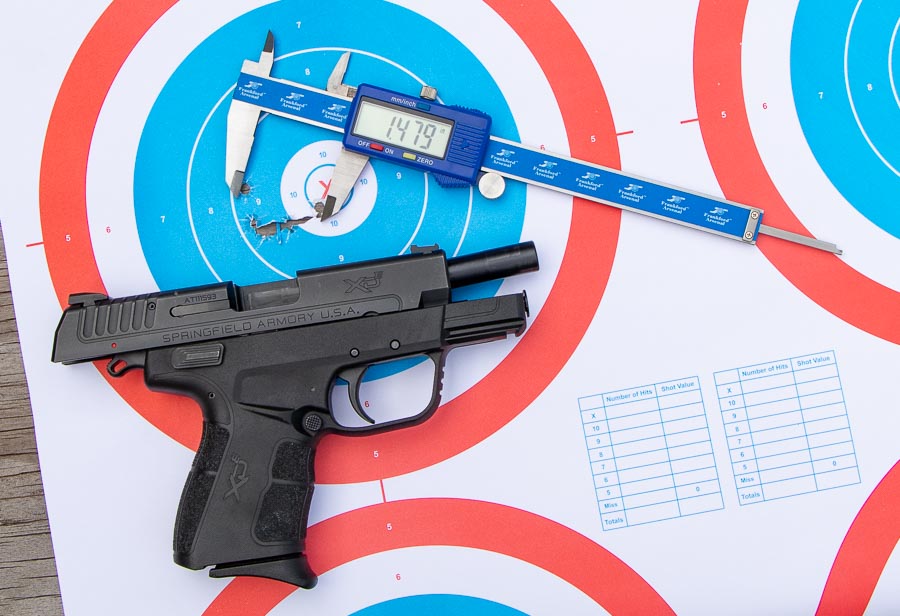
I ran the gun through about 1,200 rounds total. Federal HST, Speer Gold Dot, Hornady Critical Defense, and a bunch of Winchester white-box FMJ for practice. Zero malfunctions. Everything fed, fired, and ejected exactly as it should. The gun is boringly reliable, which is exactly what you want in a defensive pistol.
Practical Carry Considerations
The XD-E is one inch wide which is about the same as most single-stack carry guns. It carried well for me in both appendix and strong-side IWB. The exposed hammer doesn’t snag on clothes, or at least it didn’t for me.
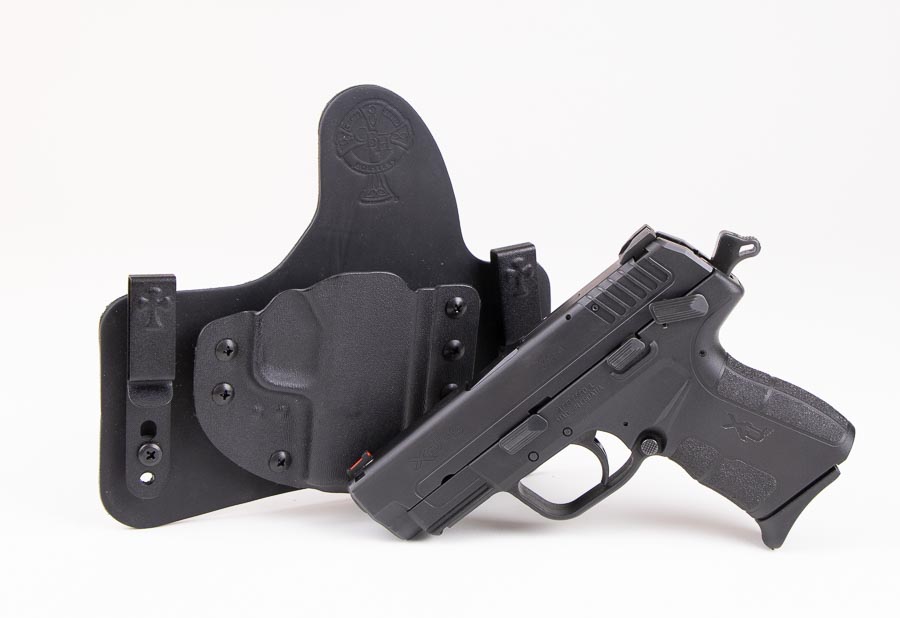
Magazine capacity is 8+1 with the flush-fit magazine, 9+1 with the extended. The extended mag adds about half an inch to the grip length. I preferred the flush magazine for carry and kept the extended as a spare. Eight rounds of 9mm isn’t a lot by modern standards, but it’s comparable to other single-stack nines and more than I could stuff in my S&W J-frame revolver that I used to rely on.
How It Compares to Competitors
The XD-E exists in a strange middle ground. It’s sized like a Glock 43 or Shield, but it operates like a old school pistol. Let’s break down the comparisons.
Versus Glock 43
The Glock is slightly smaller and about two ounces lighter. Not a huge difference, but noticeable if you’re carrying all day. The flip side to that is the XD-E is offering substantially more ammo in the magazine (8 or 9 vs. 6 with the Glock).
The fundamental distinction is the trigger system. The Glock 43 uses a striker-fired mechanism with a consistent 5.5-pound pull for every shot. The XD-E gives you that DA/SA.
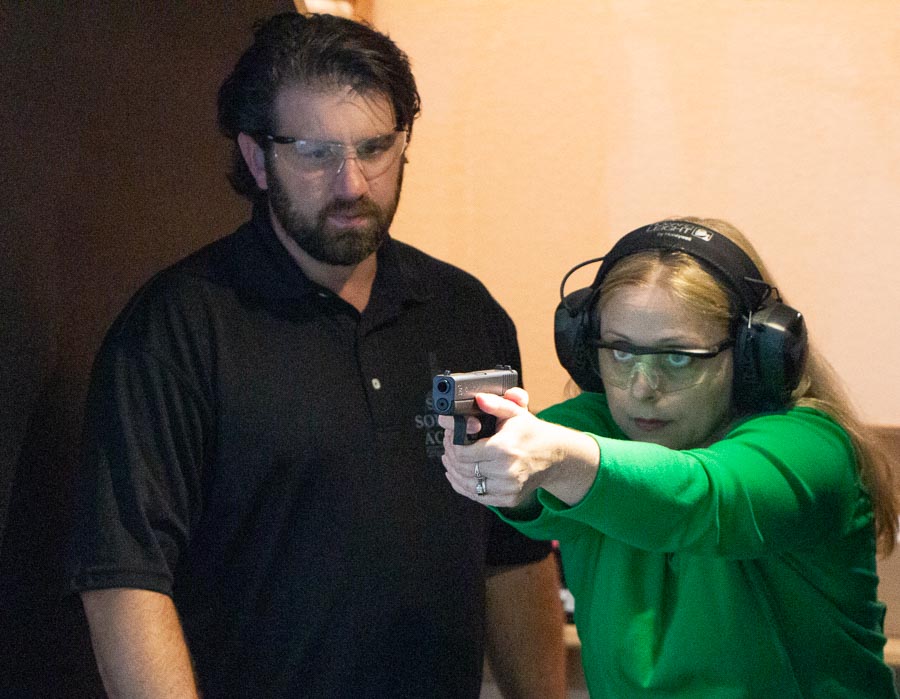
Aftermarket support heavily favors the Glock. Holsters, sights, triggers, barrels: everything exists in quantity for the 43. The XD-E has decent holster options, but nowhere near Glock’s ecosystem.
The XD-E’s low-effort slide is easier to rack than the Glock 43. I’ve tested both extensively, and the difference is real. For shooters with arthritis or limited grip strength, this could be the deciding factor. For everyone else, both slides work fine.
Reliability is equivalent. Both guns run without issues. Accuracy is comparable at defensive distances. The choice comes down to a preference for manual of arms and whether you value the striker’s simplicity or DA/SA control.
I’ve reviewed the Glock 43, and I like the gun. I’d favor the G43 over the XD-E. But there’s no wrong answer here. Both are proven carry guns.
Versus Hellcat
The Springfield Hellcat represents a different design philosophy from the same manufacturer. The Hellcat is striker-fired and holds 11+1 rounds in a package that’s actually slightly smaller than the XD-E. If capacity matters most to you, the Hellcat wins decisively. Eleven rounds versus eight or nine is a meaningful difference.
But the Hellcat doesn’t have a DA/SA trigger system. You don’t get the long first pull. You don’t get multiple carry mode options. And the Hellcat’s slide is harder to rack: not by much, but enough that people with hand strength limitations notice.
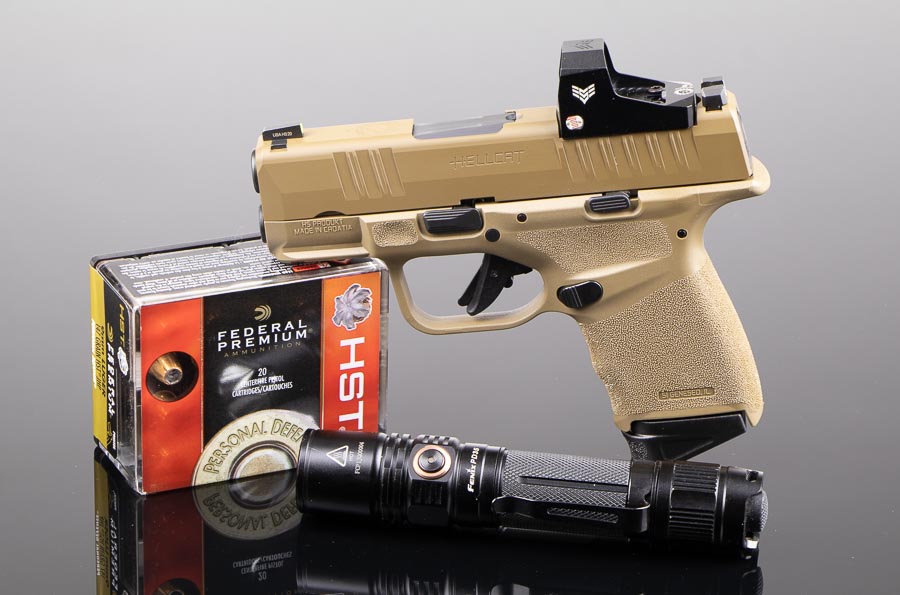
Both guns are reliable. Both shoot well for their size. The Hellcat is more modern, currently in production, and offers better aftermarket support. If you want maximum capacity in a micro-compact, get the Hellcat.
One other consideration: the Hellcat has an optics-ready version. The XD-E doesn’t. If you plan to run a red dot, that’s another point in the Hellcat’s favor.
I’ve reviewed the Hellcat, and I find it to be a great self-defense pistol. For me, I would pick the Hellcat over the XD-E. But my favorite CCW gun is currently the Hellcat Pro, which is a slightly larger (and easier to grip) version of the Hellcat.
Versus Smith & Wesson Shield
The original M&P Shield and XD-E are similar in external dimensions. Both weigh around 23 to 25 ounces loaded. Both use single-stack magazines. Both are designed specifically for concealed carry.
I liked the Shield 9mm a lot when I reviewed it. I still do. But, I also feel like there are better options on the market today. The XD-E may be one of them. I like the feel of the XD-E slightly more than the Shield.
The Shield uses a striker-fired system with a hinged trigger safety. Consistent pull weight around 6.5 pounds. Some people find this slightly heavier than ideal, but it’s fine.
Capacity favors the XD-E slightly. The Shield holds seven or eight rounds depending on magazine choice. The XD-E holds eight or nine. One round isn’t a massive difference, but if you’re counting, there it is.
Aftermarket support is strong for the Shield, which has a longer production history and arguably better holster selection.
For me, this one is a toss up. I like the trigger on the Shield better, but the overall feel of the XD-E is nicer than the Smith & Wesson.
Versus SIG P365
The SIG P365 changed the micro-compact market when it launched. Ten rounds standard, twelve with the extended magazine – all in a package barely larger than the XD-E. That capacity advantage is significant.
The P365 is striker-fired with a flat-faced trigger that breaks around 5.5 to 6 pounds. Crisp and consistent. The reset is short. It’s a genuinely good trigger for a carry gun.
Size comparison is interesting. The P365 is actually slightly shorter in both length and height than the XD-E. It accomplishes the higher capacity through aggressive grip design and magazine engineering. The double-stack magazine makes it marginally thicker, but that’s barely noticeable in carry.
The P365 has optics-ready variants and an enormous aftermarket. Holsters, magazines, sights, and grip modules all exist in quantity. It’s currently one of the most popular carry guns on the market. The XD-E can’t compete there.
Early P365 models were reported to have reliability issues. SIG addressed them, and current production guns run fine. The XD-E has been reliable from the start. Both shoot well. Both are accurate.
For me, the SIG is the winner – unless you want the DA/SA trigger or have hand grip strength.
Versus XD Subcompact
The XD Subcompact is the XD-E’s striker-fired cousin. Same manufacturer. The Subcompact is a double-stack gun, so it holds 13+1 rounds of 9mm compared to the XD-E’s 8+1 or 9+1. That extra capacity comes at a cost as the XD Subcompact is noticeably thicker and heavier. About a quarter inch wider and four ounces heavier.
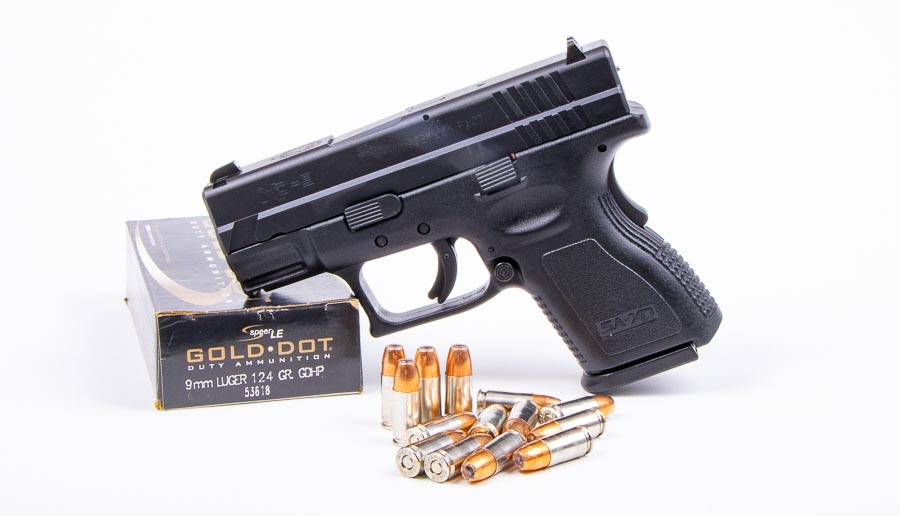
For concealment, the XD-E has the advantage. That single-stack profile disappears easier under a shirt.
Although a much older design, the Subcompact is still in production. Parts and magazines are easy to find. Aftermarket support is solid. The XD-E is discontinued, though not impossible to source.
Although I like and own a XD9 Subcompact, I think I take the XD-E for concealed carry. The first rule of CCW is “have a gun,” and the XD-E is much lighter and easier to carry. Read my XD9 Subcompact review for more information on that handgun.
Final Thoughts
Springfield discontinued the XD-E in 2021. The market spoke, and apparently, there weren’t enough buyers willing to choose a DA/SA single-stack over striker-fired alternatives. That’s fine. Markets do what markets do.
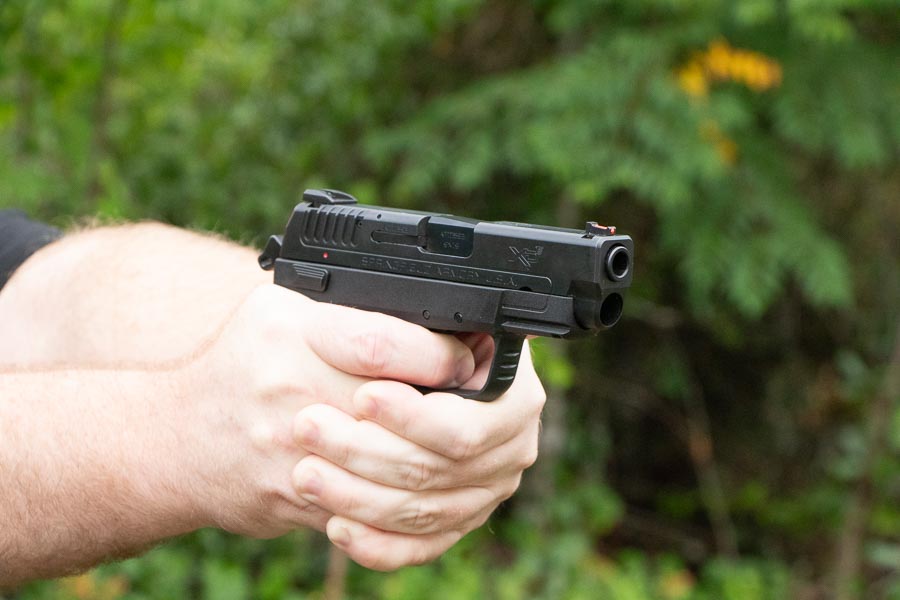
But discontinuation doesn’t mean the gun is bad. It means Springfield couldn’t justify the production costs for a niche product. The used market is still active. Prices are reasonable – typically $300 or so for guns in good condition. That’s solid value for what you’re getting.
If you’re looking for a DA/SA carry gun and you don’t want a thick double-stack pistol, the XD-E is worth finding. It’s reliable, well-built, and serves a specific purpose that most modern guns don’t address.
I carried this gun daily for three months. It worked. Never failed. Never gave me a reason to doubt it. That’s what matters in a defensive pistol. The rest is personal preference.