

Editor’s Note: For this Wilson Combat X-TAC Supergrade Professional review, the pistol and the holster were provided on loan by Wilson Combat at the writer’s request. As with every evaluation we publish, the manufacturer had no say in the testing, the findings or the final verdict.
The suspect arrived in a hard case, sat down across the bench from me, and refused to say a word. That is the way it always goes with a fighting pistol. They never confess on their own. You have to haul them out to the combat range, square them off against a century of hard-won history, and make them prove they belong in a working man’s holster. This particular arrival was the Wilson Combat X-TAC Supergrade Professional, a .45 ACP wearing a $4,795 price tag and a finish so deep that a couple of grizzled range officers went quiet when the lid came up. I sharpened my pencil, thumbed eight fat ones into the magazine, and got down to the business of the third degree.

What follows is the full Wilson Combat X-TAC Supergrade Professional review, top to bottom, the way I have done it since I traded a range command for a typewriter: numbers first, swagger second, and an honest verdict at the end for the man deciding what to carry, buy or budget for.
Why the 1911 Still Answers the Bell
Let me set the table before we start shooting. When General John J. Pershing rode into Mexico in 1916 chasing Pancho Villa, a good many of the men under his command carried a brand new sidearm called the M1911. That pistol did not arrive by accident. The Army had watched the .38 Long Colt come up short against determined fighters during the fighting in the Philippines, and the brain trust went looking for something with more authority. The Thompson-LaGarde tests of 1904 pointed the way, John M. Browning drew up the answer, and the .45 ACP was born. More than 110 years later, the slug is still doing honest work.
That is the lineage the Supergrade is asking you to pay for. Plenty of capable handguns ride the gun counters today, and I will be the first to credit the polymer wonders for putting reliable firepower in a lot of holsters at a fair price. But none of them carry the cachet of the 1911 platform, and none of them fill a hand the way Browning’s design does. Aesthetics should never be the first item on a defensive shopper’s list. Yet I will say it out loud: it does not hurt one bit that the 1911 looks as good as it feels, and the men in blue who carry one tend to shoot it a little straighter for loving it a little more.
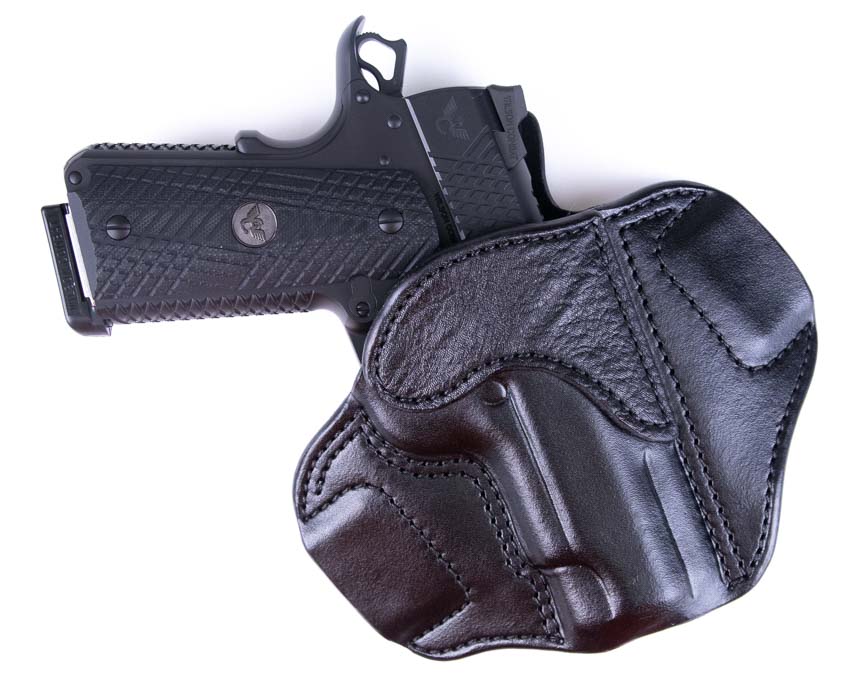
Wilson Combat sits near the top of the modern 1911 heap. The Berryville, Arkansas, shop builds a deep catalog of pistols on the original Browning blueprint, and for a great many serious shooters the name is the first word in custom defensive firepower. That reputation is exactly what the X-TAC Supergrade Professional has to live up to. Bill Wilson and his people set out to build a no-compromise fighting pistol, and they sent me one to find the cracks.
What Kind of Gun Are We Dealing With Here?
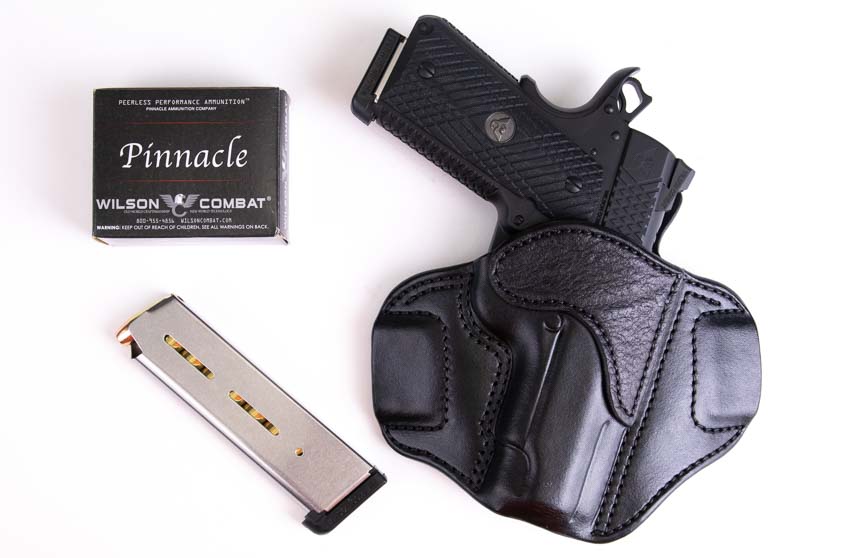
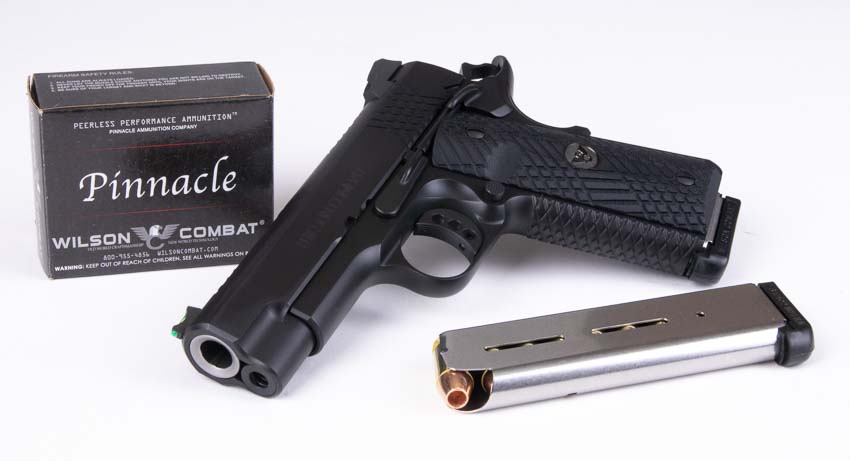
Wilson Combat offers the X-TAC Supergrade in several flavors, including a full-size, a Commander and a compact. The Professional is the version that landed on my bench, and it splits the difference in a way I happen to favor. I ordered mine in the classic .45 ACP, though the buyer who prefers a lighter recoil impulse or a flatter trajectory can have the same gun in 9mm or .38 Super. The single-stack magazines hold eight rounds of the big-bore cartridge and ship with branded bumper pads, which is a small courtesy that tells you the factory was paying attention.

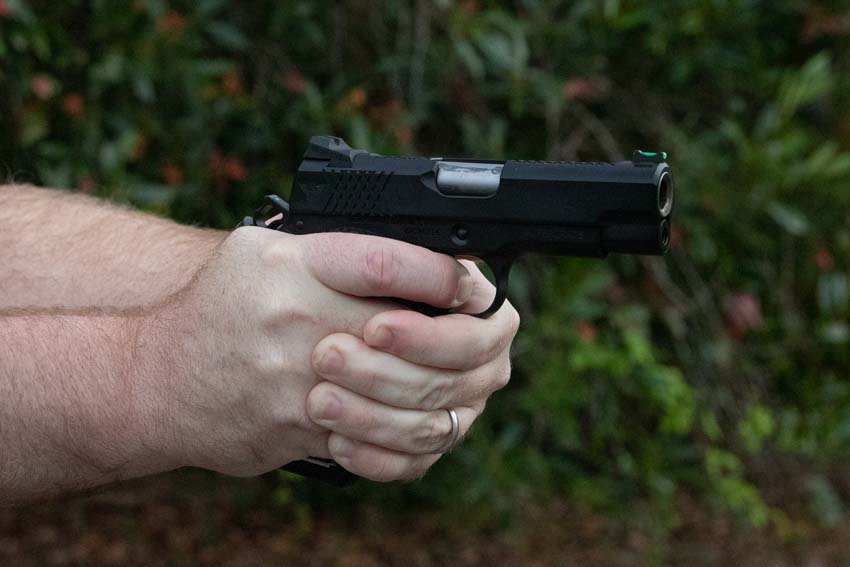
The Professional runs a 4-inch barrel under a full-length grip. Now, to a certain breed of 1911 purist this is heresy, and I can already hear the letters being drafted. Save the stamp. I like the 4-inch guns better than the full 5-inch government models. They balance cleaner in my hand, they clear leather a hair quicker, and I do not feel like I surrender anything that matters at defensive distance. Wilson Combat clearly agrees that a shorter tube does not gut accuracy, because the company guarantees this pistol will print 1.5 inches at 25 yards. That is a bold say-so to put in writing, and we will see in a moment whether the gun makes the company a liar.
The vital statistics read like a fighting pistol should. Overall length is 7.6 inches, weight is 38 ounces, and the finish is Wilson’s matte black Armor-Tuff, which shrugs off sweat, holster wear and the general abuse a carry gun absorbs. Capacity is 8-plus-1. The action is straight single-action, the way the good Lord and John Browning intended.
Specifications
- Caliber: .45 ACP
- Barrel: 4 in.
- Overall length: 7.6 in.
- Weight: 38 oz.
- Grips: Black G10, X-TAC pattern
- Sights: Green fiber-optic front, Battlesight rear
- Action: Single action
- Finish: Matte black Armor-Tuff
- Capacity: 8+1
- MSRP: $4,795
Sights, Texture and a Trigger Worth Talking About
The Supergrade Professional wears a bright green fiber-optic front sight that the eye grabs in a hurry, day or shade. Out back sits Wilson’s Battlesight fixed rear with a deep, wide U-notch. Under stress, when the heart is hammering and the hands are not steady, that big notch lets you find the front sight fast and drive it onto the kill area for a quick defensive hit. When you have the time and the steadiness for precision work, you simply level the tops of the front and rear blades and squeeze. I will take this arrangement over most factory three-dot setups every day of the week.

Here is the part the gun-store crowd tends to overlook, and the part that matters most to a man who carries for a living. Malfunctions happen. Shoot any pistol long enough and it will choke, and the cruel arithmetic of this work says the choke may come in the middle of a life-and-death fight, possibly with one hand out of commission. That flat front ledge on the Battlesight rear is not styling. You can hook it on your belt, a tabletop, your shoe or a car door and rack the slide one-handed to clear the stoppage and get back in the fight. I test for that. This gun passed.
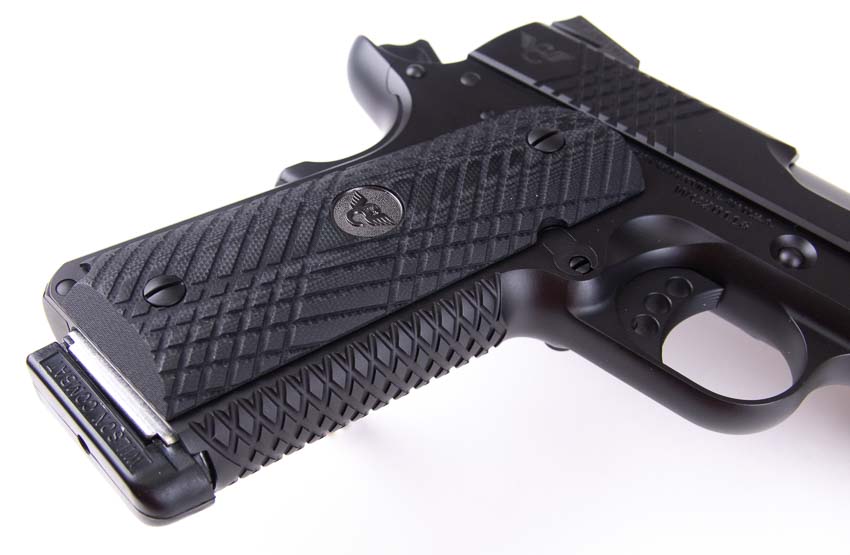
Wilson lays its proprietary X-TAC treatment across the frontstrap, the mainspring housing and the top of the slide. The pattern is an aggressive X-cut texture that throws up rows of little diamonds, and it is a small marvel of split-the-difference engineering. It anchors to the palm like a burr and kills slippage during recoil, yet it will not chew up a dress shirt the way sharp checkering or raised pyramids can. The black G10 grip panels carry the same X-TAC pattern and a Wilson Combat medallion, and they fill the hand without adding a bit of unwanted bulk.
Then there is the trigger, which is where a 1911 earns its keep. My Lyman digital gauge read a consistent 3.8 pounds across a string of pulls, and for once the number tells most of the story rather than half of it. There is a whisper of take-up, then a clean glass-rod break, then a short, positive reset that puts you right back on the next shot. It is one of the finest factory triggers to cross my bench in a long stretch, and it flatters the shooter without ever feeling unsafe for serious carry.
On the Combat Range
I will admit something. I get paid to shoot guns and then tell you about them, and I would be a fool not to know how good I have it. Even so, some days at the range beat others, and the day I ran the X-TAC Supergrade was one for the keeper file. The 1911 generally feels right in my fist. This one felt like it had been built around a casting of my own hand.
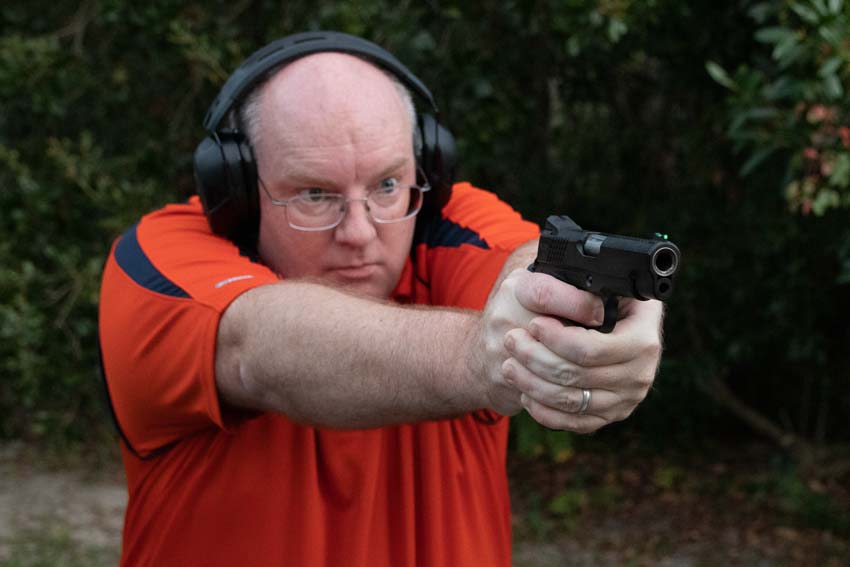
So how does the X-TAC Supergrade Professional shoot? It shoots like a pistol that costs $4,795 ought to shoot, which is to say it ran clean, hit where I looked, and gave me nothing to complain about. As hard as I tried to dig up a flaw, the gun would not cooperate. It ran exactly as designed and served up a portion of something I do not often confess to in print: fun.
Velocity: Running the Loads Across the Screens
First order of business was the chronograph, with the screens set 9 feet in front of the muzzle. I fed the Supergrade four of Wilson Combat’s own defensive loads, and each one printed honest numbers. The 160-grain TAC-XP +P, a lightweight copper hollow point built for speed, clocked an average of 994 feet per second. The 185-grain TAC-XP averaged 967 fps. The heavier jacketed loads came in where physics says they should: the 200-grain XTP at 922 fps and the full-house 230-grain XTP at 786 fps.
Run the arithmetic and the spread tells the story. The lightest bullet leaves the muzzle roughly 26 percent faster than the heaviest, while the 230-grain slug carries about 44 percent more mass downrange. That is the eternal trade in a defensive .45: velocity and a fast-opening bullet on one end, momentum and deep penetration on the other. The Supergrade digested all four without a hiccup, which is exactly what you want to see before you bet your life on a magazine.
Ammo Testing
| .45 ACP Load | Velocity | Energy | Accuracy |
|---|---|---|---|
| Hornady Critical Duty 220-gr. +P | 917 fps | 411 ft-lbs | 1.12″ |
| Liberty Ammunition Civil Defense 78-gr. JHP +P | 1,844 fps | 589 ft-lbs | 1.25″ |
| Wilson Combat 160-gr. TAC-XP +P | 994 fps | 351 ft-lbs | 0.83 in. |
| Wilson Combat 185-gr. TAC-XP | 967 fps | 384 ft-lbs | 0.87 in. |
| Wilson Combat 200-gr. XTP | 922 fps | 377 ft-lbs | 0.79 in. |
| Wilson Combat 230-gr. XTP | 786 fps | 315 ft-lbs | 0.89 in. |
Velocity is an average of five shots, measured by a chronograph 9 feet in front of the muzzle. Velocity measurements are in feet per second. Accuracy is listed in inches for a five-shot group at 7 yards shot off-hand.
Practical Accuracy Beats Bench Accuracy
Wilson backs this pistol with that 1.5-inch guarantee at 25 yards. Frankly, that is finer shooting than most men can reliably wring out of any pistol without a bench rest, and I include myself in that confession. Bench testing has its place for approximating what a barrel can do on its best behavior, but a Caldwell Lead Sled does not carry a gun, draw a gun or fight with a gun. A man does.
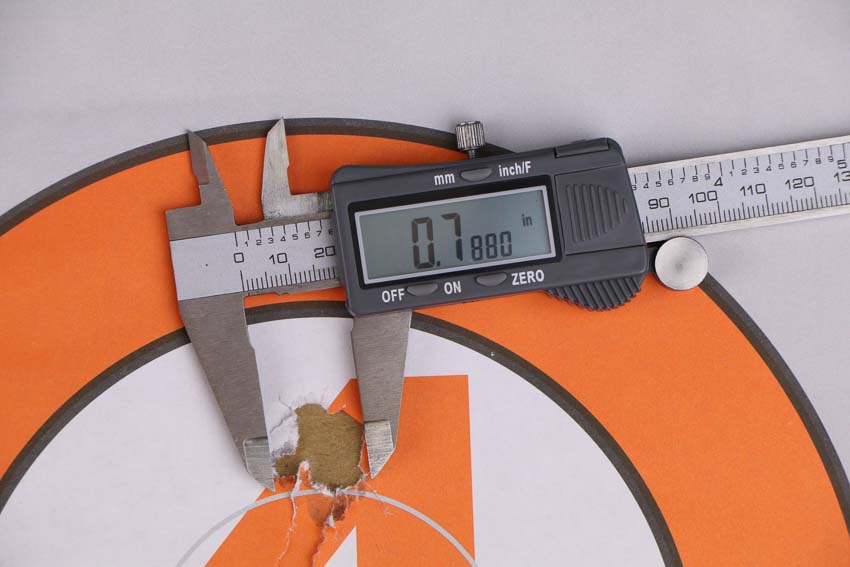
So I shoot for practical accuracy. By that I mean the gun’s real ability to put rounds where they belong when the sights, the trigger reach, the fit to the hand and the recoil all get a vote. A pistol with a 25-pound trigger might drill one ragged hole when it is strapped into a sled, and be all but useless to the average officer firing double-action from a standard hold. I want to know how a gun shoots in my hand, with my hold, on a clock that does not care how pretty the group looks.
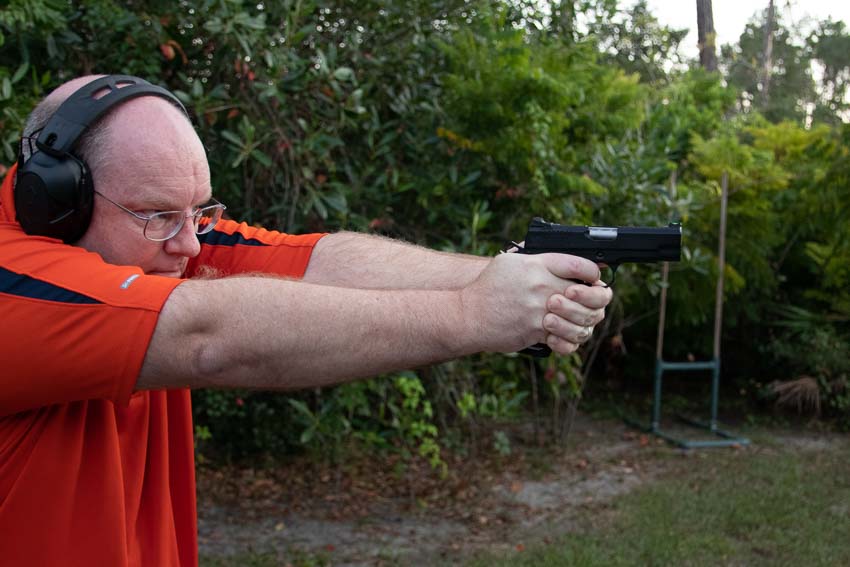
By that honest yardstick, the Supergrade was a standout. At 7 yards, hand-held, a five-shot group stayed inside an inch measured edge to edge without much fuss. Measure center to center and you can shave another 0.23 inch off those numbers. Push the target back to 15 yards and sub-2-inch clusters were the norm rather than the prize. I have no doubt this gun would make good on the factory’s 25-yard promise from a rest, and that is a rare thing to be able to say with a straight face.
Terminal Performance and the Man-Stopping Question
Most of us are not ballistics experts, and we have to judge a defensive load by what we can actually see. So I shot all four Wilson loads into Clear Ballistics synthetic gelatin and dug the slugs back out, which is the part of this job I have always liked best. Every bullet expanded, and every bullet stopped inside the block at a depth between 14.5 and 16.75 inches.
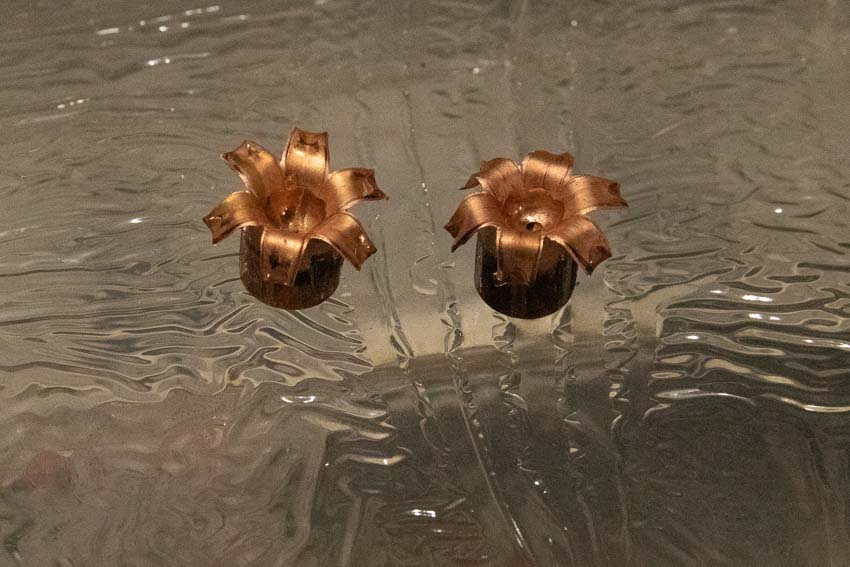
That window is the sweet spot for a working sidearm. It is deep enough to reach the vitals through an arm or heavy clothing, which is the whole point of carrying a man-stopper. And it is shallow enough that the slug is far less likely to sail clean through a determined man and keep going toward whatever, or whoever, is standing behind him. Over-penetration is not a footnote for the officer who has to answer for every round. It is the difference between a justified stop and a tragedy in the next room. These loads, in this gun, kept their business inside the kill area where it belongs.
Reliability and the 300-Round Rule
Over a lot of years and a lot of slugs, I have learned that many 1911s run happier with a healthy dose of lube than without one. A lightweight gun oil suits me best, and I have never had a lubricant give me trouble, only the lack of one.
In a maintenance video the company put out, Bill Wilson allows that he wipes down and re-oils his personal range pistol every 300 rounds. I took the man at his word, laid a light coat of oil on the slide rails and the usual wear points every 300 rounds through the test, and the Supergrade never so much as stuttered. Treat a fighting pistol like the precision instrument it is, and it will keep faith with you.
Carrying the Supergrade
Carrying a 1911 is not the chore some folks make it out to be. The slim single-stack frame actually conceals easier than a lot of the fat double-stack guns crowding the cases, and the buyer who claims a 1911 is too much pistol to pack has usually not tried in earnest. Wilson sent along one of its custom leather rigs to make the point: the Lo-Profile II, an open-top, strong-side holster cut for outside-the-waistband carry. The black leather is molded tight to the gun, and a band of shark-skin trim adds a touch of flash. It is a handsome rig, and it matches the pistol the way a good hat matches a good suit.
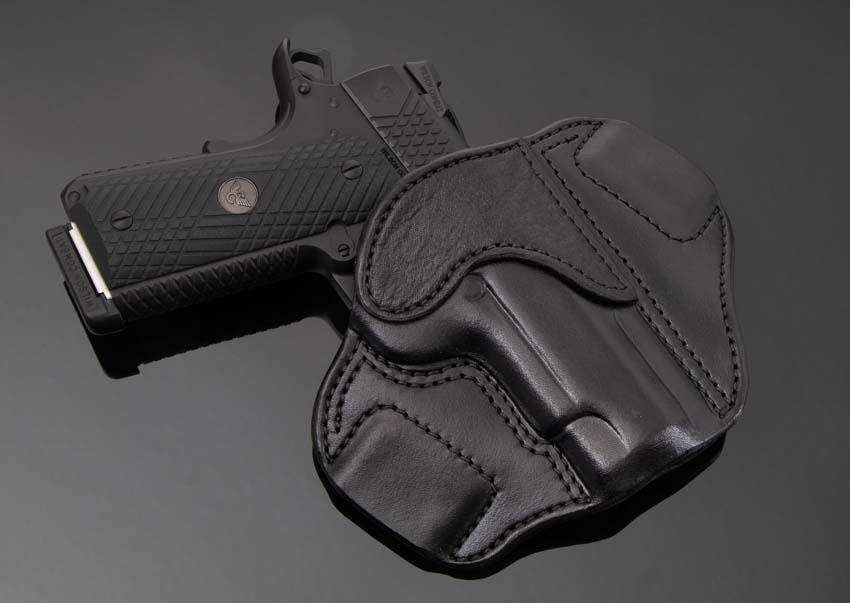
On the hip it disappeared. The Supergrade rode comfortably strong-side, the holster held it snug through several weeks of daily carry, and the leather showed barely a mark for the duty. A man could make a fair argument that this gun and this rig add up to the finest barbecue gun in the county. I would never sentence a pistol this capable to dress-up duty alone, but I will agree that the combination makes a statement bound to start a conversation around the grill.
The Verdict
Wilson Combat trades on a reputation for high-grade firearms and the service to back them, and the X-TAC Supergrade Professional only deepened my respect for the brand. From the balance to the precision machining, every surface looked and felt like money well spent. More to the point for a man who carries, the gun was utterly reliable and flat-out accurate when it counted.

Now for the honest hedging, because this column has never traded in pure swagger. At $4,795 this is not a pistol a chief is going to issue by the crate. No department budget I have ever consulted on would field a roomful of these, and that is fine, because that is not who this gun is for. The Supergrade is the connoisseur’s carry piece, the reward for the officer or the serious citizen who has decided to own one truly excellent thing and shoot it for the rest of his life. Judged on that scale, it earns the freight.
Think of it like a supercar that happens to be a daily driver. You may grab something more pedestrian for the run to the grocery store, but when you want to show the world you have arrived, the Wilson Combat X-TAC Supergrade Professional will sit on your hip as easily as a Bugatti or a McLaren sits in your drive. It made good on the factory’s say-so, it never blinked under the lamp, and it gave me a verdict I do not get to write often: I could not find a single thing to fault.