
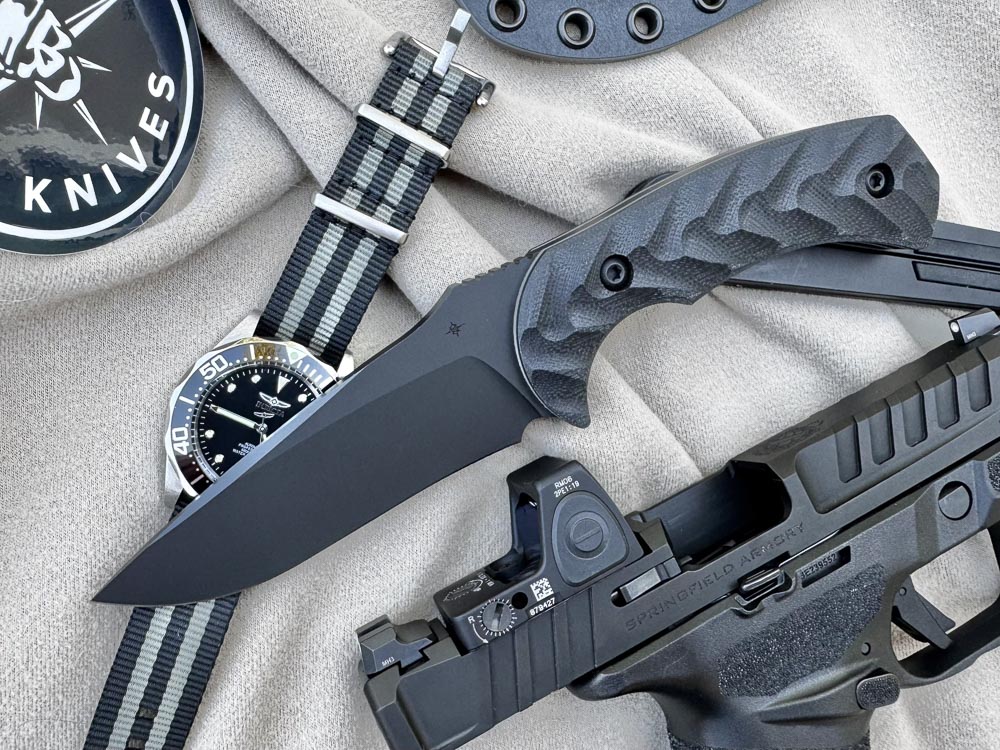
Toor Knives Mullet Review
In today’s review, Randy takes a close look at the Mullet S fixed blade knife from Toor Knives. The knife was provided by the company to the author for review. No agreement for a positive review was made or requested. All other items shown in the photos are personally owned by the author. Some links in this article are affiliate links.
Toor Knives make high-performance blades and tools. While you may be unfamiliar with the brand, we should all support products that are Made in the USA. Toor is no exception.
My esteemed editor arranged for a Toor Knives Mullet S knife to be drop shipped to my locale. I very much approved of it at the unboxing.
[You can see the knife on the company’s website here.]
About Toor Knives
A bit about Toor Knives. USMC veteran Connor Toor is the CEO and founder of the company. Connor states, “After continually encountering extremely expensive knives in the marketplace, with long production times always attached to them, I decided to take matters into my own hands and built my own forge in 2014.”
Connor based his tools on his experiences in Afghanistan during Operations Freedom Sentinel and Resolute Support, during which he was awarded a Marine Corps Achievement Medal with Combat Distinguishing Device and a Combat Action Ribbon. Toor was frustrated with his Marines “having to rely on mass-produced knives that were unfit for mission-specific tasks.”

Mullet Fixed Blade Knife
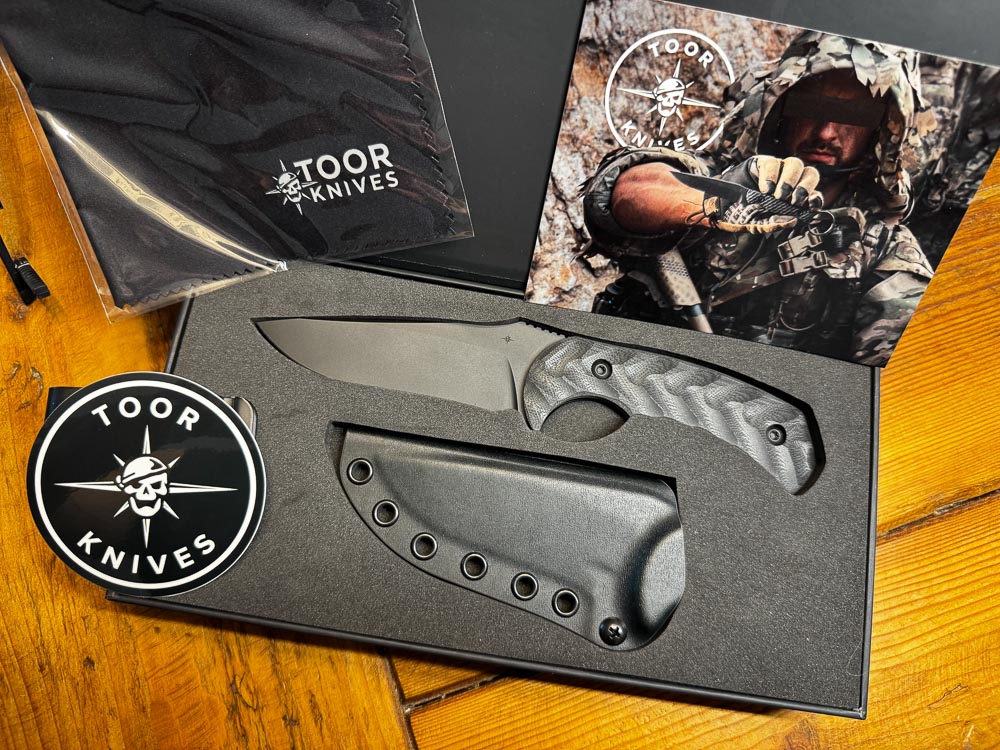
My Mullet S arrived in a black presentation box with a Kydex sheath, literature, Toor sticker, microfiber cloth, and a tube of FrogLube for protecting the blade’s uncoated edge and bolts. All Toor knives get this upscale introduction, and it befits a premium knife with a $325.00 price.

The Mullet model I received was the “S,” or standard grind. There is also a Mullet T that has a tanto grind. Other specialty knives in Toor’s Mullet line are the Mullet Patriot with red, white, and blue handle liners and the Pin-Up Mullet, a collaboration with tattoo-style artist Ben Caldwell.

The Toor Mullet S is a tactical knife that falls into the sweet spot of an everyday carry blade in its footprint. With a 4-inch blade and 8.5 inches overall, the Mullet can perform serious tasks but still be welcome on a belt or bag.
Drop Point Blade
CPM M4 is the blade steel of the Mullet at 0.1875 inches in thickness. This is a full tang construction. M4 is a tool steel known for its high strength and wear resistance. It is not stain-resistant steel since it has just 4% chromium, far short of the 10.5 %+ where steel is considered “stainless.” This is not an issue since the Toor’s blade comes coated in a black satin finish KG Gunkote. Phantom Grey is also a choice.

With a dropped point, the Mullet’s blade has a swedge at the spine that stops short of the tip, leaving it very strong up front for piercing. The bevels of the knife are flat ground, and there is a small secondary bevel. Yes, it is very sharp out of the box. I noticed that the blade has a slight recurve, which should aid in cutting. There is also a grooved thumb ramp.
Tactical Grip
The handle scales are bolted to the tang with Torx bit fasteners. There are gray liners under the black G10 scales. The scales are reminiscent of a pattern popularized by Danish custom knife maker Jens Anso some years ago. Toor calls theirs Dynamic Fluting. It is more of an angular pattern than Anso’s.

The curve of the lower fore-grip of the handle keeps your hand safe from running up on the edge. The knife’s downturned rear and aggressive scales allow the user to support a good hold in either forward or reverse grip slashes.

At the butt of the tang, Toor has included a pressed-fit tungsten carbide ball, they call a Breacher Ball for the breaking of standard, tempered, and safety glass. I like this so much better than some knives’ pokey carbide tip that takes away the user’s ability to use the rear of the tang for thumb purchase in an ice pick grip. The ball is benign.

Features and Field Use
Toor makes a Kydex sheath for its knives. This black one has a gray inside that mirrors the gray liners underneath the handle scales. The sheath is lined with a felt or similar fabric. Adjustable retention is achieved with a bolt and soft washer near the mouth of the sheath. Grommets provide mounting points.

You can use your own mounting hardware or buy a variety of belt and MOLLE attachments at the virtual point of sale on Toor’s website. For fun, I bolted on a UltiClip3.

This versatile device clamps onto a waistband or pocket lip to hold the knife fast. I especially prefer this for carrying a larger fixed blade in a rear pocket. The knife is out of the way yet easily withdrawn.

As expected, the Mullet S excelled at slicing and hacking. I ran it through a battery of media from rope to wood to cardboard and it stayed sharp. The strengthened point made for great penetration into a stack of cardboard.

I even attacked a length of dried bamboo, which is very hard across the grain. The recurved edge of the Mullet whacked its way into the fibrous substrate easily. Despite my intrusions, the black Gunkote was little affected and showed only light scuffing.
Toor Mullet S Specifications
Here are the specs on the Mullet knife:
| Overall Length | 8.5″ |
| Blade Length | 4.0″ |
| Handle Length | 4.5″ |
| Handle Material | G10 |
| Blade Steel | CPM M4 |
| Blade Thickness | 0.1875″ |
| Blade Hardness | 59-61 Rockwell |
| Weight | 7.5 oz |
Final Thoughts on the Mullet Review
Toor Knives touts the Mullet line as “Business in the front, party in the back.” Well, this sharp blade certainly will get the work done. As for party, I guess the flair of the handle qualifies in this respect. We now have three kinds of mullet in Florida. One is a bad hairstyle, one is tasty when smoked, and the third is a great piece of EDC gear.
If you are interested in this knife, you can get additional information from the company’s website here.

I liked the tiny Breacher Ball on the tang, it feels sturdy for glass work without getting in the way. The only hitch might be the low-chromium M4 steel; without the black KG-Gunkote coating it could start to rust if you keep it wet.
The market is already shifting toward higher-chromium or stainless alloys for the tang, which should curb rust even when the coating wears. That evolution will keep the ball functional while improving durability in wet conditions.
Can the Torx bit fasteners on the handle be removed with a standard 3mm Torx driver for cleaning the scales?
I gave the Kydex sheath a try, but the snap closure seems to loosen after a few weeks, making the knife shift a bit when I pull it out quickly. I’m wondering if the sheath’s fit is meant to be tighter or if it’s just a break-in issue.
I appreciate the thorough walk-through of the handle’s dynamic fluting, yet it would be useful to know how the grip performs when hands are sweaty or wet, since that can be a make-breaker for everyday carry. A quick note on the knife’s overall weight or balance would also help readers gauge its comfort during long-term use.
While the $325 price tag feels steep, the inclusion of a tungsten-carbide Breacher Ball and a custom-molded Kydex sheath does add functional utility that many budget knives lack, making it a reasonable investment for those who anticipate glass-breaking or heavy-use scenarios. For a casual carrier who rarely needs those capabilities, the cost may outweigh the everyday benefit.
The little tube of FrogLube tucked into the box is a thoughtful touch; it makes quick maintenance of the uncoated edge almost effortless. I also like how the microfiber cloth adds a practical way to keep the blade clean without extra accessories.
I was intrigued by the dynamic fluting pattern on the G10 scales, but in my own field tests the angular grooves caught on rope rather than improving grip under load. Still, the full-tang construction held up surprisingly well when I used the blade as a makeshift pry bar to open a stubborn crate, which suggests the design isn’t just for show.
I noticed the blade has a subtle recurve–does that really improve slicing performance on rope or fabric, or is it mainly aesthetic? The idea of a curved edge on a compact 4-inch drop-point is intriguing, and I’m curious to see how it behaves in real-world cuts.