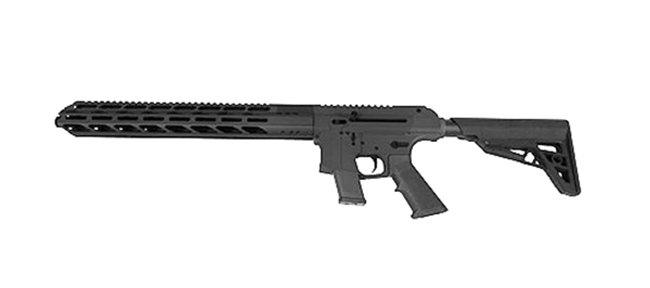
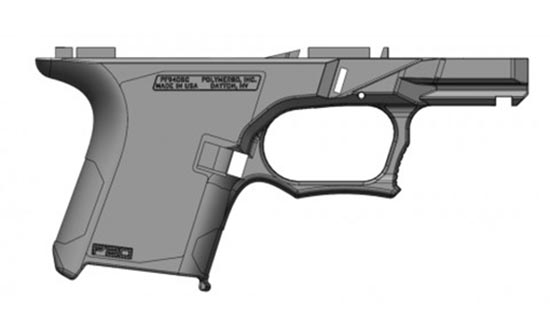
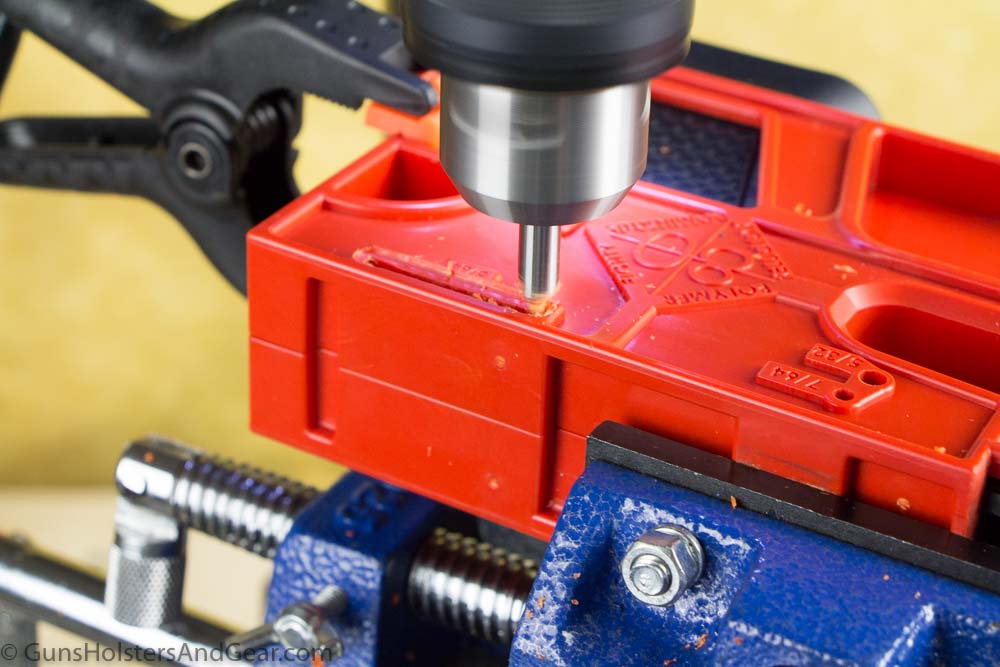
Building your own AR-15 from an 80% lower has become a popular hobby. Of course, there are many other firearms you can build from scratch as well: everything from a 1911 to a 10/22.
Firearm manufacturing is a highly regulated industry, and everyone wants to stay within the bounds of the law. So, what is, and is not, legal when making your own gun?
In this article, I am addressing one specific question: Do you have to engrave a serial number on your completed firearm?
Read This First
Before I go any farther: I am not a lawyer and have no specialized knowledge of the law beyond what anyone else can research. Nothing in this article should be considered legal advice. To put it in perspective, I’m just a guy with a keyboard – but then, so is that guy on Reddit or Facebook handing out advice. Carefully source your own information.
None of the information in this article applies to state or local laws. It applies only to the federal laws of the United States. Additionally, this information applies only to non-NFA items. All NFA items require serial numbers and other markings.
Laws change. At some point in the future, the laws regarding homemade firearms may change and render this information obsolete. Do your own homework and err on the side of caution.
Please note: the laws and ATF rules have changed since I wrote this article! Be sure to read the section at the end on the ATF serial number requirements for a look at the current state of things.
Am I required to apply a serial number to a gun I manufacture?
Short Answer: No
Long Answer: My research indicates there is no federal law or regulation that requires a person to mark his or her personally manufactured firearm with a serial number or other information. I had this confirmed by the Firearms Industry Programs Branch of the Bureau of Alcohol, Tobacco, Firearms and Explosives (BATFE).
Additional Information
Federal law does not prohibit an individual from making a fully functional firearm for his or her own use. Further, you do not need a federal firearms license (FFL) to manufacture the gun. Refer to 18 U.S.C. 922 (firearms crimes) and 18 U.S.C. 923 (firearms licensing) in public law. The BATFE acknowledges this here.
However, you cannot make the gun with the intent to sell or otherwise transfer the gun to another. This prohibition includes making a gun as a gift for an immediate family member. However, building a gun for yourself that you later decide to sell or transfer is permissible. I would strongly urge caution, as the practice of making a gun for another is prohibited without a license. It would be up to you to prove that you made it for yourself and then later decided to sell or give it away.
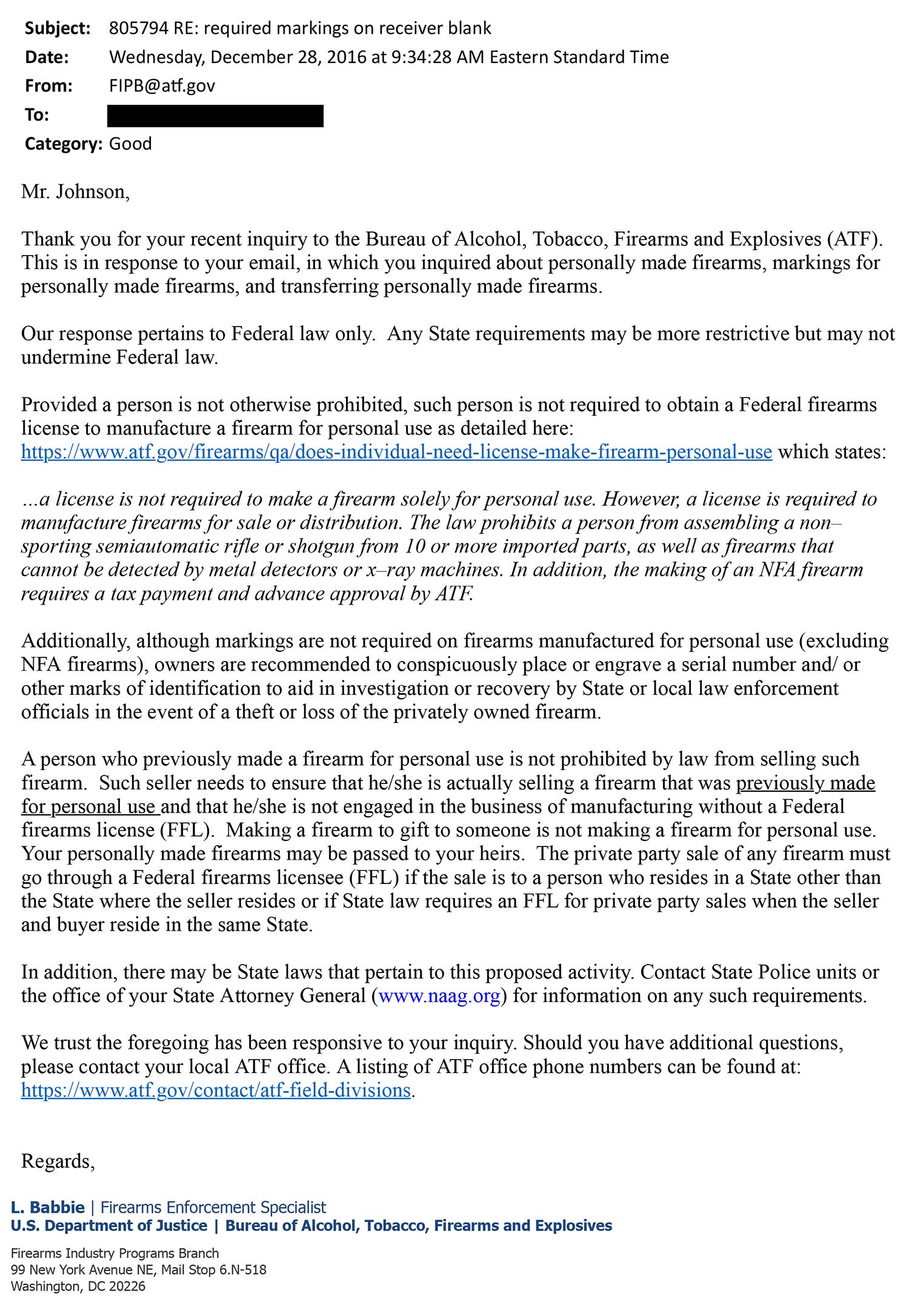
I’ve never been able to find any reference in federal law to a serial number or other manufacturing marks being required on a personally made firearm. When I contacted the BATFE about this in December of 2016, Firearms Enforcement Specialist L. Babbie of the Firearms Industry Programs Branch in Washington DC stated:
Additionally, although markings are not required on firearms manufactured for personal use (excluding NFA firearms), owners are recommended to conspicuously place or engrave a serial number and/ or other marks of identification to aid in investigation or recovery by State or local law enforcement officials in the event of a theft or loss of the privately owned firearm. (emphasis added)
I have never found any credible information that contradicts Specialist Babbie’s statement. Keep in mind this is all referring to federal law – not state law. Individual states may pass laws that require serial numbers on home made firearms.
What about a gun I make for myself and later transfer?
Short Answer: No
Long Answer: My research indicates there is no federal law that requires a personally made firearm that was manufactured for personal use to have a serial number of other marking before you sell or transfer it to another person. However, the BATFE muddies the water on this one because of the way they phrase certain things, and that people do not read the underlying CFR referenced by the agency.
However, when directly questioned about the requirement, BATFE has stated that no serial number is required in this specific case. I suggest reading the additional information below.
Additional Information
This answer is disputed by some gun owners, though it seems clear to me.
Federal law does not prohibit the transfer of a homemade firearm to another person so long as the gun was not made with the intent of transferring it to another person. In other words, when you made the gun, if it was your intention to keep and use it yourself then it is legal to later sell, gift or trade the gun to another person and not be in violation of the manufacturer licensing requirements in federal law.
This information was also confirmed by Specialist Babbie:
A person who previously made a firearm for personal use is not prohibited by law from selling such firearm. Such seller needs to ensure that he/she is actually selling a firearm that was previously made for personal use and that he/she is not engaged in the business of manufacturing without a Federal firearms license (FFL).
The gun may be transferred in any of the normal ways including face-to-face sales within a state (where not precluded by local law), through an FFL or by passing of the weapons to an heir.
However, Specialist Babbie was careful to note:
Making a firearm to gift to someone is not making a firearm for personal use.
In other words, you cannot make your son a hunting rifle and give it to him for Christmas unless you hold an FFL.
So, since it is obvious that transferring a personally made firearm is legal, let’s address the question of what, if any, marking requirements are there on a gun being transferred. This is where the BATFE causes confusion.
I have been unable to find any public law or CFR that requires a serial number or other marking on a personally made and owned firearm that is later transferred. None.
However, the BATFE makes the statement here that:
Receivers that meet the definition of a firearm must have markings, including a serial number. See 27 CFR § 478.92 (Firearm manufacturers marking requirements).
Unfortunately, the BATFE does not link to the regulation for people to review. I suspect that few people take the time to look up 27 CFR § 478.92. But I have, and it can be read here.
The regulation states quite clearly:
You, as a licensed manufacturer or licensed importer of firearms, must legibly identify each firearm manufactured or imported as follows…
As someone who is not an FFL holder who is making a gun at home and for your own personal use, this CFR simply does not seem to apply.
I have seen an image of part of a letter that is presumably from the BATFE on this subject that further confuses the subject. In the letter signed by Sterling Nixon, Chief, Firearms Technology Branch, Nixon makes the statement:
…a nonlicensee may manufacture a semiautomatic rifle for his or her own personal use…However, if the firearm is transferred to another party at some point in the future, the firearm must be marked in accordance with the provisions set forth in 27 CFR § 478.92 (formerly 178.92).
Since the words “must be marked” appear, people sometime assume that means the personally made and used firearm that is now being transferred must be marked. However, the full statement includes “must be marked in accordance with…27 CFR § 478.92”, which clearly only applies to FFL holders. In other words, as I understand it, not placing markings on the gun would not take you out of compliance with 27 CFR § 478.92, so long as you did not otherwise fall under the requirements of the CFR.
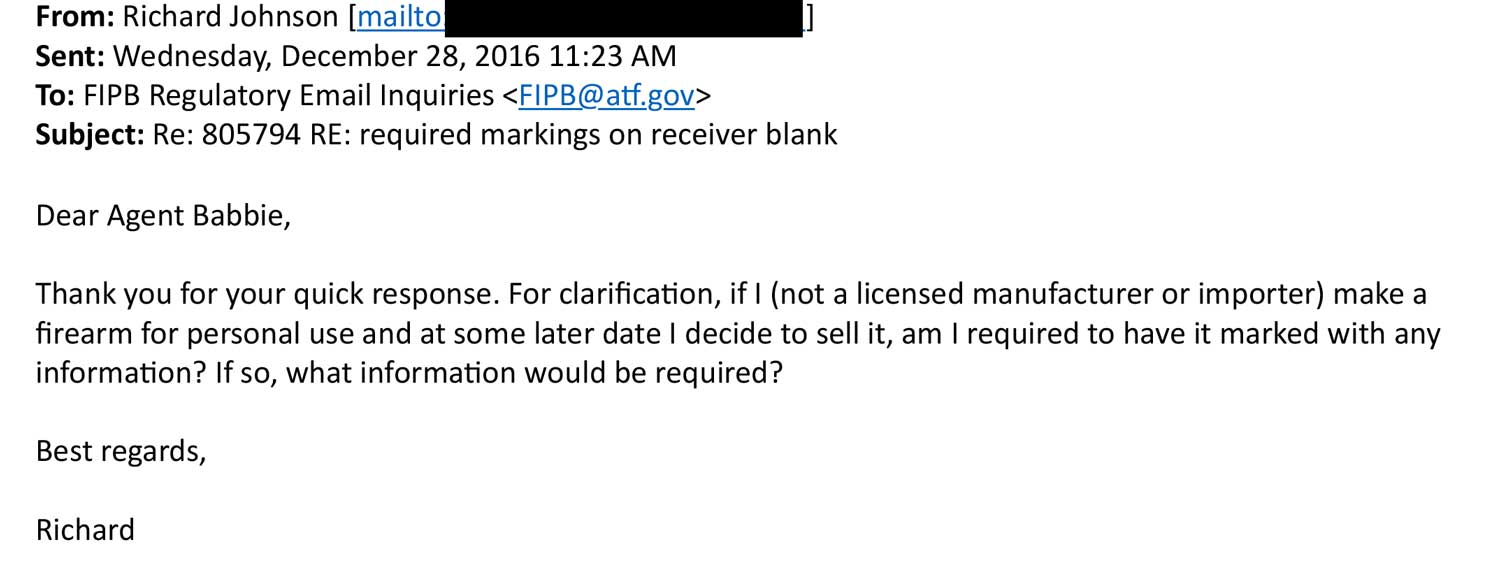
I confirmed this through a series of e-mails with Specialist Babbie when I asked this question:
For clarification, if I (not a licensed manufacturer or importer) make a firearm for personal use and at some later date I decide to sell it, am I required to have it marked with any information? If so, what information would be required?
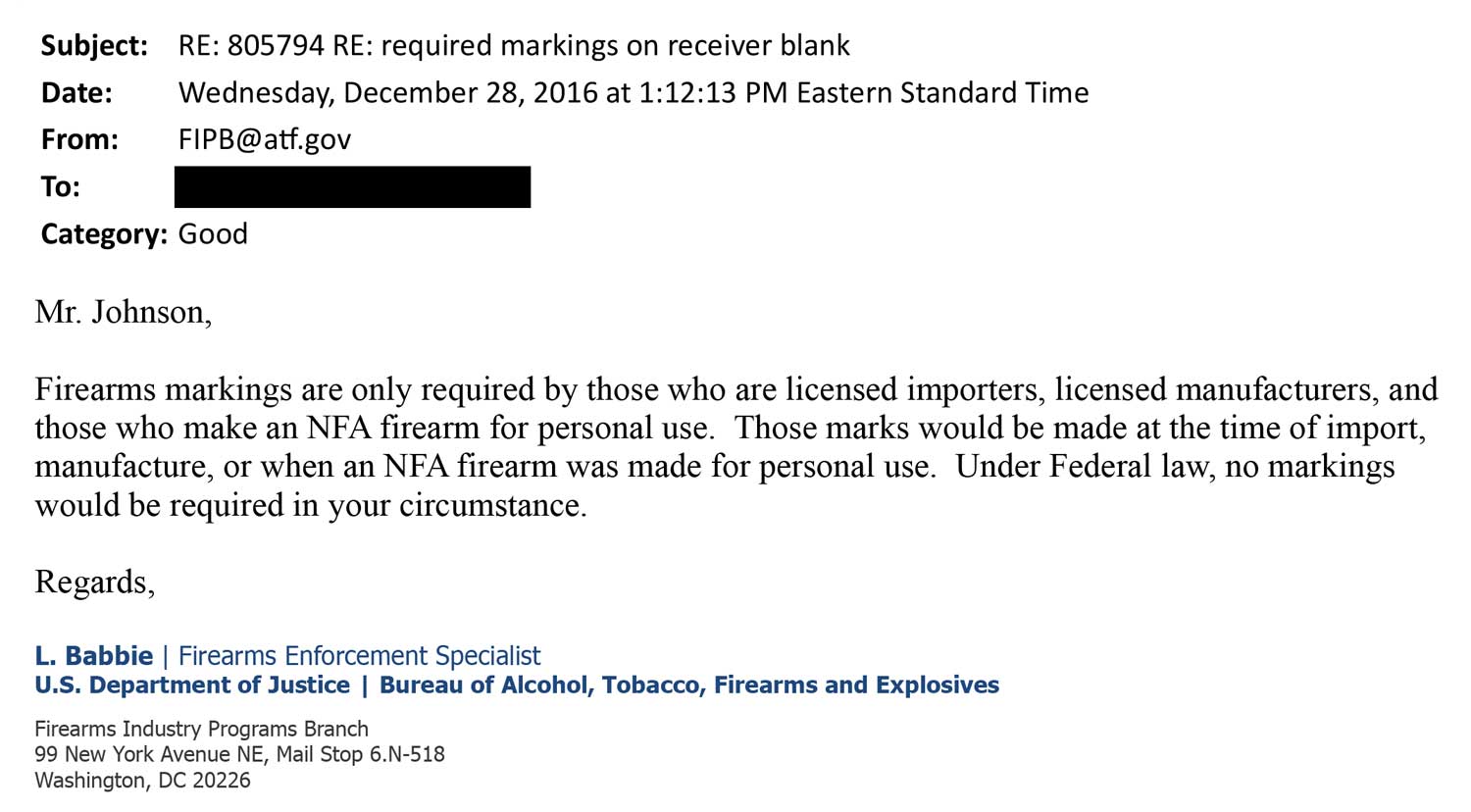
Specialist Babbie provided this clear and unambiguous response:
Firearms markings are only required by those who are licensed importers, licensed manufacturers, and those who make an NFA firearm for personal use. Those marks would be made at the time of import, manufacture, or when an NFA firearm was made for personal use. Under Federal law, no markings would be required in your circumstance. (emphasis added)
So, with the following information:
- no law I’ve been able to find or seen cited requiring a serial number or other marking;
- no CFR I’ve been able to find or seen cited requiring a serial number or other marking; and
- a BATFE Firearms Enforcement Specialist saying no serial number or other marking is required
it seems fairly clear that no serial number or other marking is required on a firearm that you personally made for your own use that you later decide to transfer.
Again, I urge extreme caution. The presumption in law is that you need an FFL to manufacture firearms for sale to others. It would appear that you need to be able to prove that the personally made gun was for you and used by you and not intended for transfer to another person.
Should I apply a serial number to my gun anyway?
Short Answer: Yes
Long Answer
There are two good reasons why you should consider marking your gun in accordance with 27 CFR § 478.92 even though it is not required. First, it avoids any confusion about the application of 27 CFR § 478.92. Consider this a CYA, though I don’t think it to be a strong enough reason for me. I have no intention of ever selling, trading or otherwise transferring any gun that I may make to someone else.
The second reason, however, is much more important to me. Marking your firearm with a serial number and other information will allow it to be identified as a stolen firearm if it is ever taken from you. Firearm thefts happen, and a serial number allows local law enforcement to enter the weapon into the National Crime Information Center (NCIC).
When an officer comes across some gang banger with your gun, that serial number will come back as stolen. The thug in possession will go for a felony and the officers might be able to track back and find out who broke into your home. Cops getting criminals – especially violent ones – off the street is something I fully support. A serial number on your gun can help that happen should it ever be stolen.
Additional Documentation
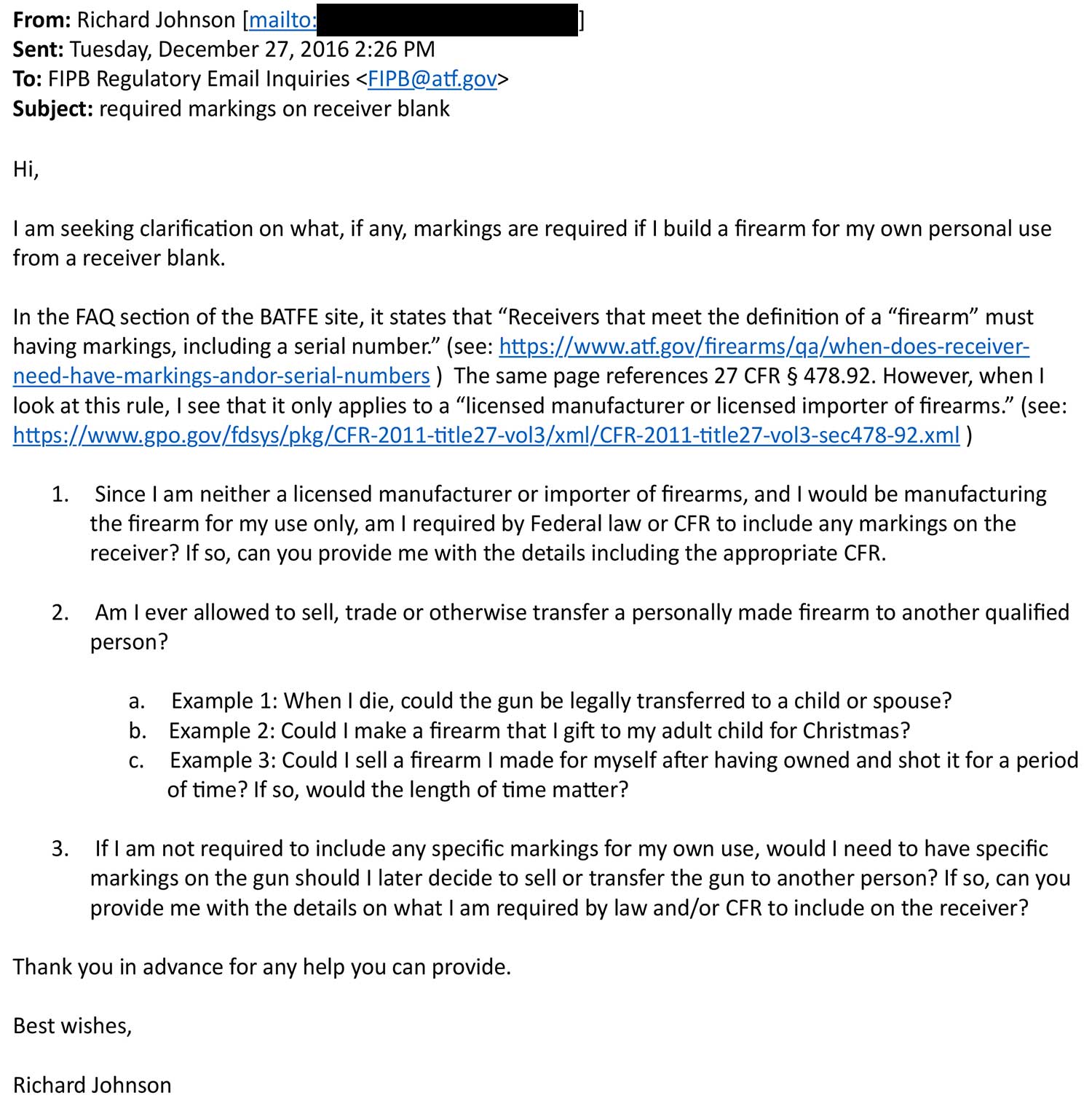
This is the initial e-mail I sent to the BATFE seeking clarification on the issues surrounding the manufacture and marking of personally made guns:
This is the response I received:
I then followed up with this question:
and received this response:
ATF Serial Number Requirements – Update
This year has been wild for ATF rulings, changes and lawsuits. Currently, the ATF is attempting to enforce its new rules regarding what constitutes a “receiver.” Many people believe the new ATF rule is both illegal under the existing Federal law and unconstitutional from both the 2nd Amendment and the Separation of Powers clause.
Lawsuits are flying and at least one judge made a determination that the application of any serial number to a firearm may be unconstitutional. [Do NOT rely on this as a criminal defense!]
Right now things are fluid, and I would recommend doing your own research and contacting an attorney for any questions you may have. Do not take anything in this article as legal advice!
Last update: October 23, 2022